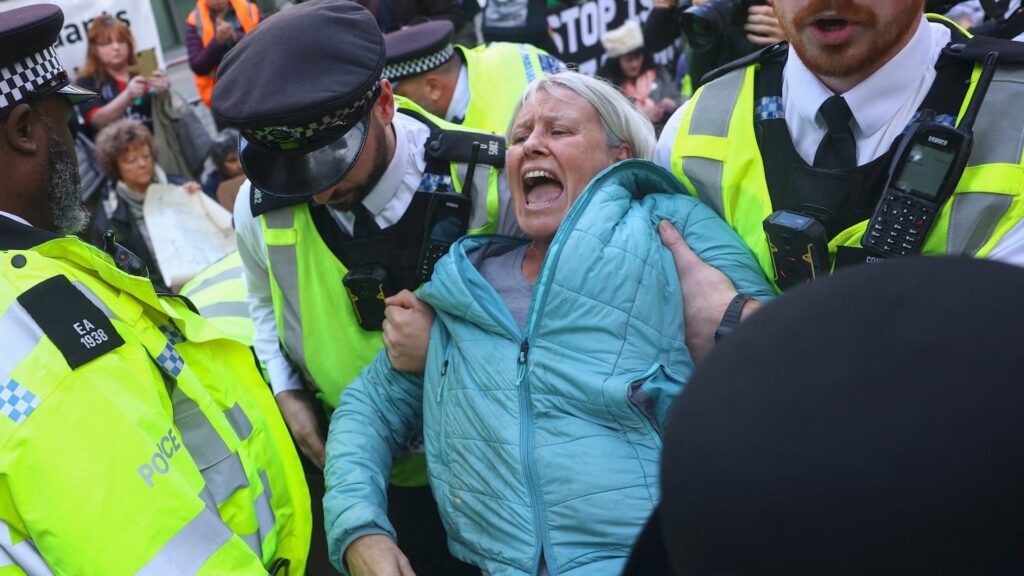
Hundreds of protesters gathered outside the United States Embassy in London in a significant demonstration opposing the UK government’s decision to ban Palestine Action. The protest was marked by heightened tensions that led to the arrest of several Palestine Action supporters.
Palestine Action, a grassroots activist group known for its direct actions in support of Palestinian rights, recently faced a ban by the UK government. This move has sparked outrage among human rights advocates and supporters who view the ban as a suppression of legitimate protest and free speech.
On the day of the protest, demonstrators converged near the US Embassy, chanting slogans and holding placards that called for solidarity with Palestine. Organizers emphasized that the protest aimed to challenge both the ban on Palestine Action and the broader policies of the US and UK regarding the Israeli-Palestinian conflict.
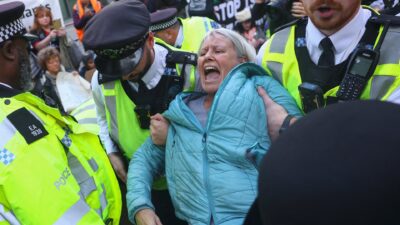
The atmosphere outside the embassy was charged, with police officers present in large numbers to maintain order. Despite attempts to keep the protest peaceful, some Palestinian Action supporters were arrested by law enforcement agencies for alleged breaches of public order.
The arrests have raised further debates around the limits of political protest and the government’s role in managing dissent. Supporters of Palestine Action argue that the crackdown represents a broader pattern of silencing activists who criticize Israeli policies and Western governments’ complicity.
International observers noted that the protest was part of a wider movement advocating for Palestinian rights and calling attention to the humanitarian situation in the occupied territories. The event highlighted the ongoing tensions between activist groups and state authorities over the right to protest and freedom of expression.
Legal experts have expressed concerns about the implications of the ban and arrests for democratic freedoms in the UK. They pointed out that while security and public order are important, any restrictions on activist groups should be carefully scrutinized to avoid undermining civil liberties.
The US Embassy, for its part, issued a statement acknowledging the protest and reaffirming its commitment to working towards a peaceful resolution of the Israeli-Palestinian conflict. However, the embassy also emphasized the importance of respecting local laws and the rights of all individuals.
In response to the arrests, Palestine Action and allied organizations have vowed to continue their advocacy efforts through legal channels and public awareness campaigns. They have called on international communities to support the protection of human rights and freedom of speech.
The protest and subsequent arrests exemplify the complex and often contentious nature of activism related to the Israeli-Palestinian issue in Western capitals. As debates continue, it remains unclear how the UK government will address the tensions between security concerns and the protection of civil rights moving forward.
This incident is likely to fuel further protests and discussions surrounding Palestine Action and similar groups, as well as international perceptions of the UK’s approach to activism and Middle East policy. Observers will be watching closely to see whether the ban on Palestine Action remains enforced or if new strategies are pursued to address the conflict and protest rights.
As the situation evolves, the role of peaceful protest, government regulation, and international diplomacy will remain key factors influencing the discourse on Palestine and the broader geopolitical landscape.