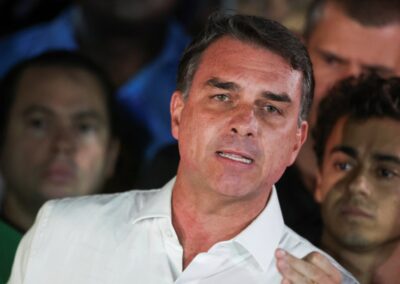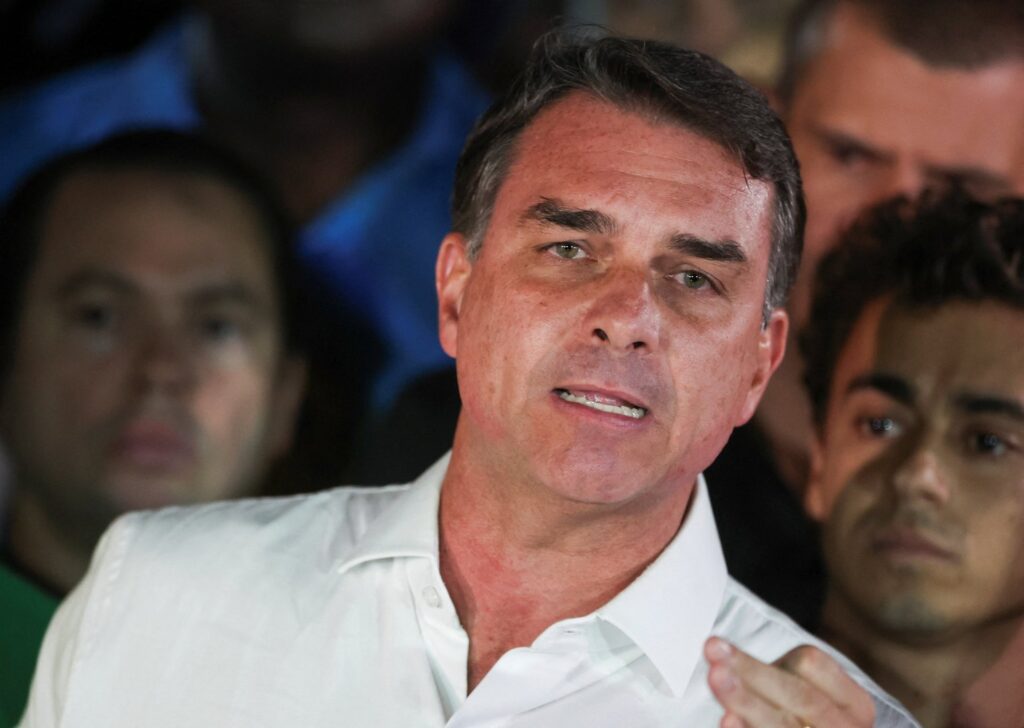
Flávio Bolsonaro, son of former Brazilian President Jair Bolsonaro, has publicly pledged to carry forward his father’s political legacy and ongoing fight within Brazil’s complex political landscape. This commitment comes amid a turbulent period in Brazilian politics, where ideological divides and contentious governance have marked recent years.
Jair Bolsonaro, who served as president from 2019 to 2022, was known for his conservative stance and polarizing policies, which elicited strong support and opposition alike. Throughout his tenure and beyond, Bolsonaro championed issues such as law and order, nationalism, and economic liberalization, which resonated deeply with a significant segment of the Brazilian population.
Now stepping firmly into the political arena himself, Flávio Bolsonaro, a current senator and prominent figure within the political right, has pledged to uphold and advance the principles and policies advocated by his father. Flávio’s statement reflects both a personal commitment to his family’s political ideals and a strategic effort to maintain influence within Brazil’s evolving political environment.
His vow to continue his father’s fight underscores ongoing challenges in Brazil, such as corruption, crime, and economic difficulties, which remain at the forefront of political discourse. Flávio Bolsonaro’s emergence as a key political actor signals the sustained relevance of the Bolsonaro political movement and its impact on Brazil’s governance.
Observers note that Flávio’s approach will be scrutinized as he balances the need to appeal to his father’s base with the demands of a broader electorate seeking stability and progress. His political future, much like his father’s legacy, will likely shape the trajectory of Brazil’s right-wing politics in the coming years.
This development is significant not only for supporters who view the Bolsonaro family as champions of conservative values but also for opponents who critique their policies and rhetoric. The dynamics around the Bolsonaro political dossier will continue to influence Brazil’s political dialogue, particularly as the nation prepares for upcoming elections and grapples with social and economic reform.
In sum, Flávio Bolsonaro’s commitment to his father’s political fight symbolizes the enduring influence of a pivotal political dynasty in Brazil. It highlights the complexities of political succession, the persistence of ideological divides, and the ongoing contest over Brazil’s future direction on the national stage.