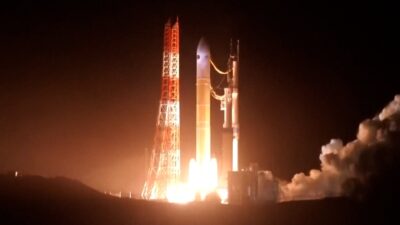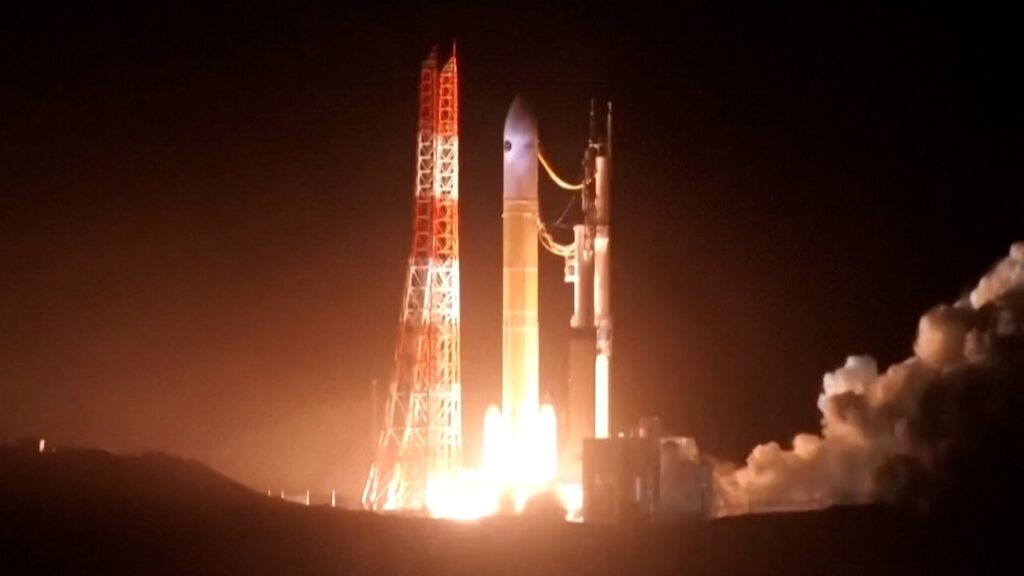
Japan has embarked on a groundbreaking space mission aimed at collecting samples from Phobos, one of the two moons orbiting Mars. This ambitious project marks a significant milestone in interplanetary exploration, with a planned duration of five years.
The mission, uncrewed and robotic, involves sending a spacecraft to Phobos to collect surface material that could provide unprecedented insights into the Martian system and the early solar system. Phobos, the larger of Mars’ two moons, is a small, irregularly shaped body that has intrigued scientists due to its mysterious origins and surface composition.
Launching from Earth, the spacecraft is designed to journey millions of kilometers across space, enter into orbit around Mars, and then navigate to Phobos. Once there, it will carefully collect samples from the moon’s surface using advanced robotic tools.
This mission is part of Japan’s expanding contributions to planetary science and exploration. The data and samples obtained will be invaluable in understanding the history and evolution of Mars, as well as providing clues about the formation of moons around planets.
The five-year timeline covers the trip to Mars, the sample collection phase, and the return journey to Earth. Scientists hope that by bringing back actual material from Phobos, they can conduct detailed laboratory analysis that is not possible with remote sensing or rover-based studies alone.
Previous missions to Mars and its moons have relied on orbital photography and rover missions primarily on Mars itself. This new approach of sample return from a moon represents a significant leap forward in space exploration technology and international scientific collaboration.
The samples are expected to shed light on the composition of Phobos, testing whether it is a captured asteroid or a fragment from Mars itself. This would also enhance understanding of Mars’ history and its potential for past habitability.
Japan’s space agency has worked extensively with international partners to develop the technology required for this mission, including advanced propulsion, navigation, and sample retrieval systems.
This historic mission underscores humanity’s growing capabilities in exploring more distant and challenging locations within our solar system. The successful return of Phobos samples will open new frontiers in planetary science and may ultimately pave the way for future manned missions to Mars and its moons.