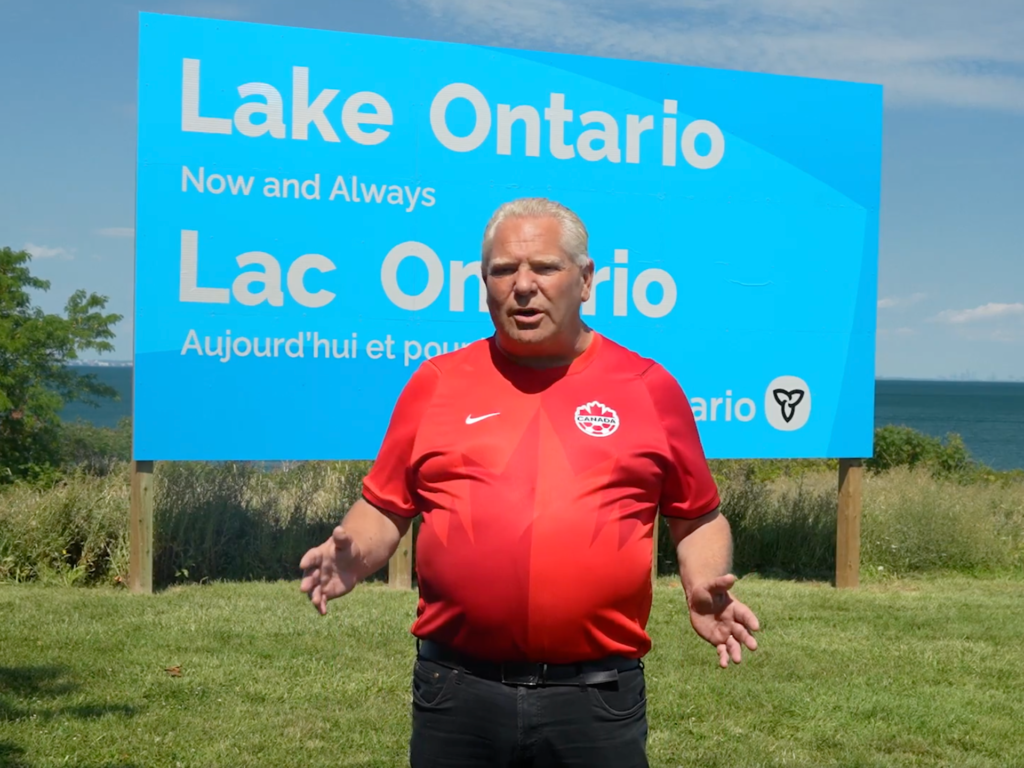
In a political and cultural exchange that has captured international attention, Ontario Premier Doug Ford has made a pointed response to US President Donald Trump’s suggestion to rename Lake Ontario as “Lake America.” Ford unveiled a new sign reading “Lake Ontario,” signaling his rejection of the proposed name change and asserting Canadian sovereignty over the Great Lake.
President Trump had reportedly proposed renaming Lake Ontario “Lake America” as part of a broader effort to emphasize American identity and pride. The idea quickly sparked controversy given that Lake Ontario is one of the five Great Lakes shared by both the United States and Canada. This body of water holds significant historical, environmental, and economic importance for both countries.
Doug Ford’s decision to install the “Lake Ontario” sign was viewed by many as a symbolic rebuke. The sign was placed prominently at a key vantage point where the lake is visible, reinforcing the existing and historically recognized name. This move highlights Ontario’s commitment to upholding its heritage and the bi-national nature of the Great Lakes region.
Political analysts interpret Ford’s action as more than just a dispute over geographic naming. It reflects tensions about national identity, regional pride, and cross-border relations between Canada and the United States amid an increasingly nationalistic political climate.
Lake Ontario spans an area of approximately 18,960 square kilometers and serves as a critical freshwater source. It also supports a diverse ecosystem and provides resources vital to the economy of both countries, including shipping routes, fisheries, and tourism attractions.
The Great Lakes are collectively the largest group of freshwater lakes by total area in the world, and Lake Ontario is the smallest of the five. The naming and joint management of these lakes have historically been governed through cooperation agreements between Canada and the U.S., making unilateral renaming proposals contentious.
Various Canadian officials and citizens expressed support for Premier Ford’s stance, emphasizing the importance of maintaining established place names that reflect the region’s history and international agreements. Local residents near Lake Ontario feel strongly connected to the lake’s identity, which fosters a sense of community and continuity.
The issue also sparked discussion in U.S. media and political circles, with some supporting the notion of promoting American symbols, while others criticized it as potentially damaging to diplomatic relations and regional cooperation.
Experts warn that such symbolic provocations could undermine ongoing efforts to address shared environmental challenges, including water quality preservation, invasive species control, and climate change impacts affecting the Great Lakes basin.
In summary, Doug Ford’s installation of the “Lake Ontario” sign is a clear message opposing the idea of renaming the lake “Lake America.” It underscores the importance of respecting historical and geographical realities, the value of binational collaboration, and the deep connections communities have with their landscapes. The exchange adds a colorful chapter to the longstanding relationship between Canada and the United States, illustrating how names and symbols remain powerful in shaping national identities and cross-border dynamics.