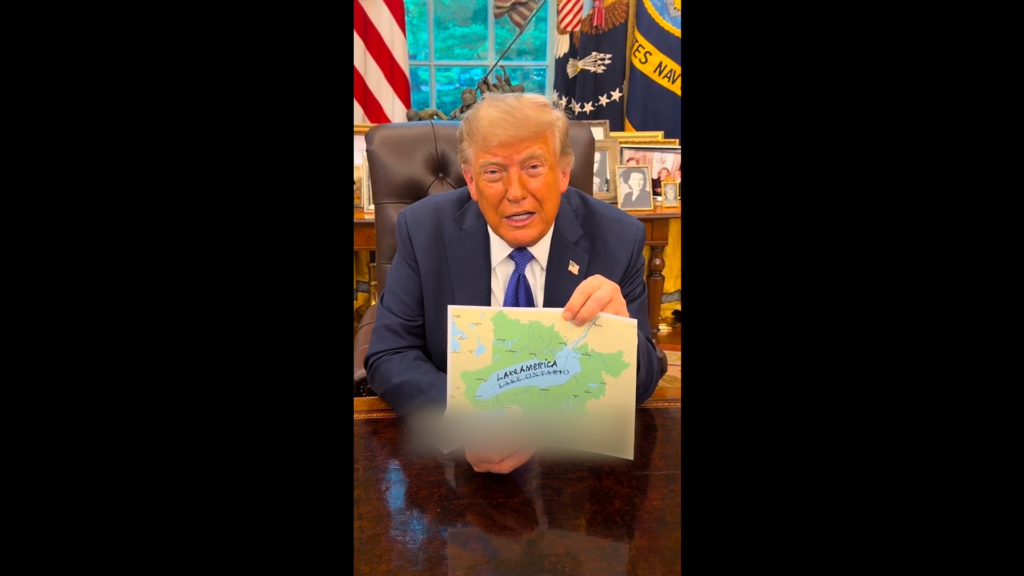
In a surprising and unconventional move, US President Donald Trump posted a video wherein he was seen crossing out Lake Ontario on a map and renaming it ‘Lake America.’ The incident quickly grabbed public attention and sparked widespread discussion across media platforms.
Lake Ontario is one of the five Great Lakes of North America, serving as a natural border between the United States and Canada. The act of crossing out a significant geographical feature and renaming it carries symbolic weight and historical significance.
The video showed President Trump using a red marker to draw a line through the words “Lake Ontario” and replacing it with “Lake America.” This visual statement was interpreted by many as a gesture of assertive patriotism, but critics argue it was an unusual and unnecessary provocation.
Political analysts see this act as part of Trump’s broader approach to assert American identity and sovereignty in various spheres, including international relations and domestic policy. Supporters lauded the gesture, praising the President for emphasizing American pride.
However, international observers and Canadian officials responded with confusion and concern. Lake Ontario’s status as a shared resource is vital for both countries, and the unilateral renaming was seen by some as a misstep that could strain bilateral relations.
Geographers and historians pointed out the importance of respecting historical and geographical names that hold cultural and ecological significance. Lake Ontario’s name originates from indigenous and colonial histories that are deeply embedded in the region’s identity.
Regular users of the Great Lakes, including fishermen, environmentalists, and local communities, also weighed in on the incident. Many expressed that while the act was symbolic, it did not change the reality of shared stewardship and cooperation across the lake.
The White House has not released an official statement to clarify the motivation behind this unusual display. Meanwhile, social media platforms saw a surge of memes, debates, and discussions reflecting varying opinions on the matter.
This event comes at a time of heightened nationalism and border security discussions in the US and Canada. It underscores how symbols, maps, and names can be powerful tools in political messaging.
While the renaming was not legally or officially recognized, it has nevertheless succeeded in drawing attention to issues of national identity and cross-border cooperation in North America. The incident raises important questions about respect, diplomacy, and the power of symbols in international relations.
As the dialogue continues, it remains to be seen how this symbolic gesture will influence future interactions between the US and Canada concerning shared natural resources and political boundaries. For now, ‘Lake America’ exists only as a bold statement in an online video, but its ripple effects are tangible in conversations worldwide.