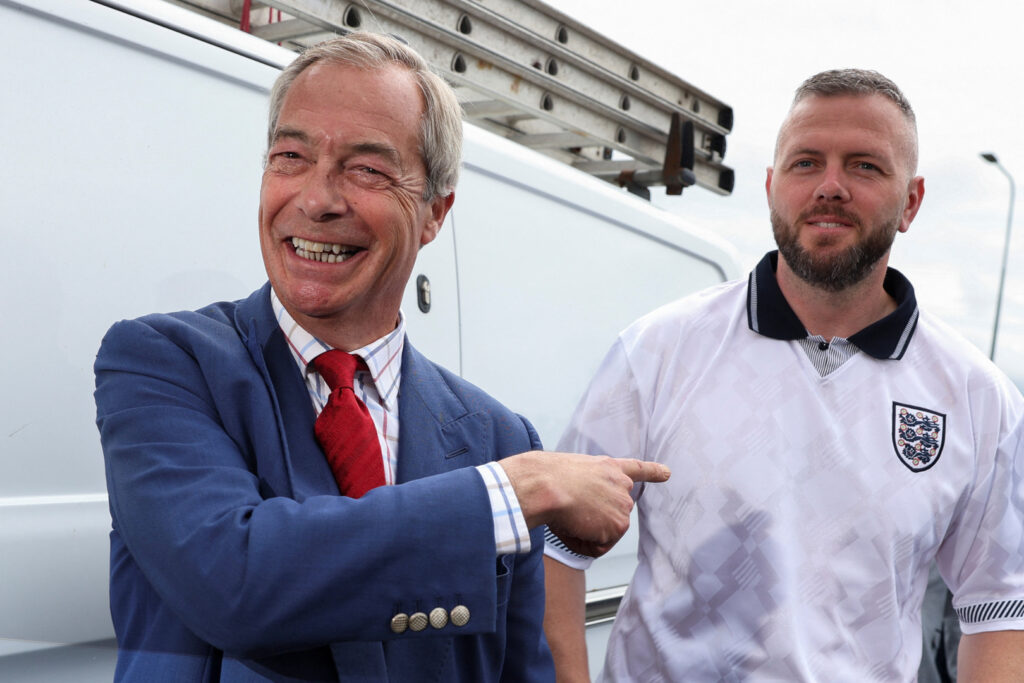
Reform UK leader Nigel Farage reacts next to Reform UK by-election candidate Rob Kenyon as they arrive during the Makerfield by-election, triggered by the resignation of Labour MP John Simons, at St. Aidan's Parish Centre, Wigan, Britain, June 18, 2026. REUTERS/Temilade Adelaja
Nigel Farage, the leader of Reform UK and prominent political figure, has announced his resignation as a Member of Parliament (MP). This decision is strategic, as Farage intends to trigger a by-election and subsequently stand in it as a candidate. His move has generated significant attention across the UK political landscape.
Farage’s political career has been marked by his strong advocacy on various issues, including Brexit. As the former leader of the UK Independence Party (UKIP) and a driving force behind the Brexit movement, his influence on British politics has been substantial. Leading Reform UK, Farage continues to push his political agenda and maintain relevance in the evolving political scene.
The announcement to resign as MP triggered discussions about his motivations. By resigning and then standing again in a by-election, Farage aims to reaffirm his mandate from his constituents. This is a tactic sometimes employed by politicians wishing to strengthen their political legitimacy or to draw national attention to specific causes or political goals.
The by-election is expected to be closely watched, not only because of Farage’s high profile but also due to the potential implications for national politics. It presents an opportunity for Farage to test his support base and potentially reinforce Reform UK’s presence in Parliament.
Political analysts suggest this move might be aimed at consolidating support ahead of broader political campaigns or elections. It also underlines Farage’s commitment to his political values and his strategy to remain a key player in UK politics.
Supporters of Farage view this as a bold move that demonstrates political courage and a willingness to directly engage with voters to secure their trust again. Critics, however, may see it as a political stunt or a tactic to maintain media attention.
The forthcoming by-election will be a significant event, with voters having the chance to make a decisive choice on Farage’s political future. It will also act as a barometer for the popularity of Reform UK and its policies in the current political climate.
This development highlights the dynamic nature of UK politics and the continual shifts in political leadership and party dynamics. Farage’s decision underscores the importance of direct electoral mandates and the value politicians place on maintaining a strong connection with their electorate.
As the situation unfolds, all eyes will be on the constituency where the by-election will take place, as well as on the broader reactions across the political spectrum. The outcome could have implications not just for Farage and Reform UK, but for the wider political discourse and power balance within the UK Parliament.
In summary, Nigel Farage’s resignation to stand again in a by-election is a calculated political move aimed at reaffirming his position and engaging directly with voters. It reflects his ongoing influence in UK politics and the strategic maneuvers politicians employ to sustain their careers and impact.
This event will be significant to monitor for political observers, party members, and the general public interested in the direction of UK politics and electoral dynamics.