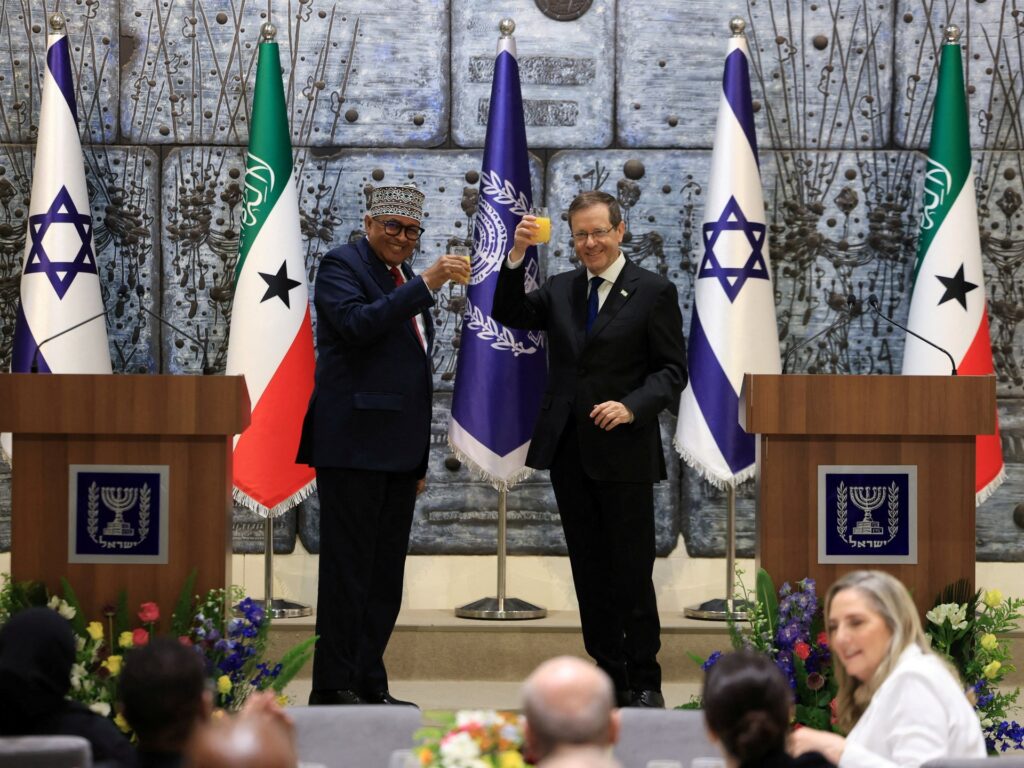
Six months after Israel officially recognized Somaliland, the two entities are transitioning from symbolic gestures to forging concrete strategic cooperation. Israel’s recent enthusiastic reception of Somaliland’s leader highlights burgeoning ties and signals a concerted effort to deepen bilateral relations.
Israel’s interest in Somaliland stems largely from the latter’s strategic location overlooking the Red Sea, a vital maritime passage key to global trade and regional security. As a small but self-declared independent state, Somaliland’s partnership offers Israel a foothold on the African coast opposite Yemen and near the Bab-el-Mandeb strait, a chokepoint for international shipping.
This burgeoning relationship underscores Israel’s broader ambitions to expand its influence across the Red Sea region. By supporting Somaliland, Israel aims to counterbalance regional powers and secure maritime routes critical to its national and economic security interests.
The cooperation between Israel and Somaliland extends beyond political symbolism to practical avenues such as security collaboration, intelligence sharing, and potential economic partnerships including technology, infrastructure, and trade development.
For Somaliland, Israel’s recognition and engagement provide a significant diplomatic boost. Despite declaring independence from Somalia in 1991, Somaliland has struggled for international recognition. Israeli diplomacy thus offers Somaliland not only validation but also potential avenues for international investment and security assistance.
Israeli officials have expressed optimism about the partnership’s future, highlighting mutual benefits and the possibility of establishing permanent diplomatic missions. Meanwhile, Somaliland’s leadership views the relationship as a strategic asset in its quest for broader international legitimacy and economic development.
This cooperation fits within the context of broader geopolitical dynamics, where multiple regional and global actors vie for influence in the Red Sea corridor, including Saudi Arabia, the UAE, and Iran. Israel’s engagement with Somaliland adds a new dimension to this competition, elevating the strategic importance of the Horn of Africa.
In summary, the transition from symbolic recognition to actionable collaboration marks a significant milestone. This evolving partnership between Israel and Somaliland not only redefines regional alliances but also heralds new strategic realities in the Red Sea basin, with implications for maritime security, trade, and diplomatic alignments across the broader Middle East and East Africa.