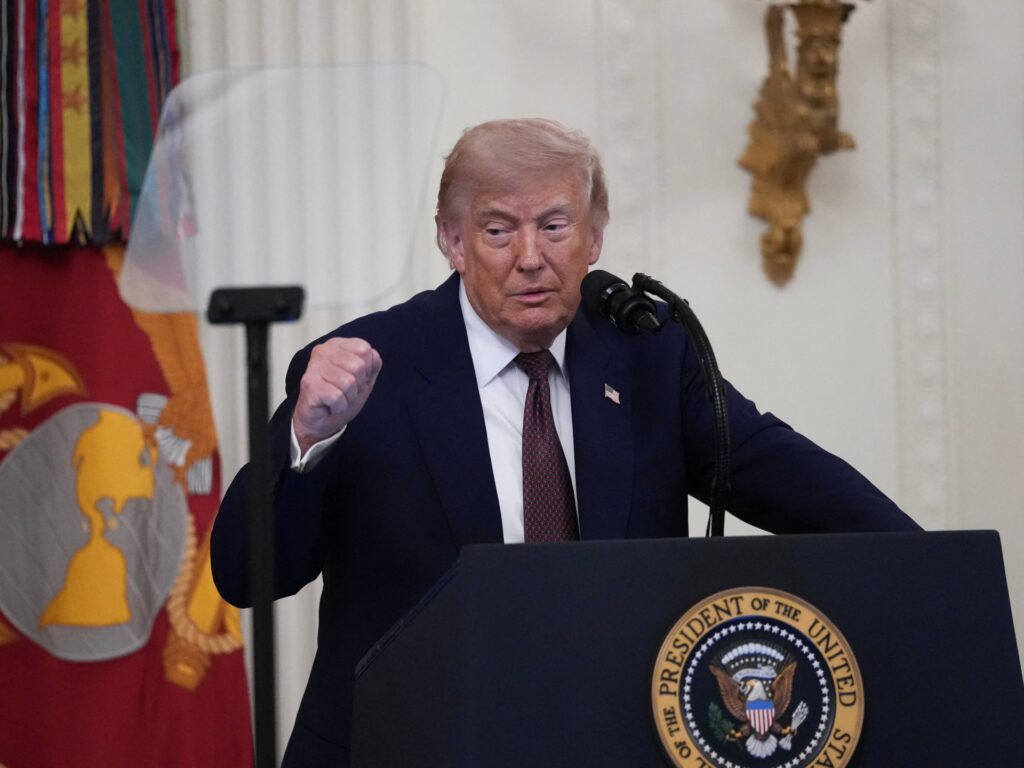
Former President Donald Trump has sharply criticized opponents of the recent Memorandum of Understanding (MoU) between the United States and Iran, characterizing the agreement as a decisive blow to Tehran. Trump declared that the deal signifies Iran’s “unconditional surrender,” signaling what he perceives as a strategic victory for the US in its complex and often tense relationship with Iran.
The MoU, aimed at addressing longstanding issues relating to Iran’s nuclear program and regional activities, has ignited a polarized debate within political and diplomatic spheres. Trump’s comments come at a time when the future of diplomatic negotiations faces uncertainty, following the announcement that US Special Envoy for Iran, R. Nicholas Vance, has delayed an impending diplomatic trip.
Trump’s assertion that Iran is “finished” reflects a hardline stance, underscoring his belief that the terms strongly favor US interests and diminish Iran’s leverage and influence. This rhetoric contrasts with other perspectives suggesting the agreement might be a stepping stone toward détente and more stable relations.
Critics, on the other hand, have expressed concern that the MoU does not go far enough in dismantling Iran’s nuclear capabilities or halting its support for proxy groups in the Middle East, warning that it might embolden Tehran. Some have accused the Trump administration of using the agreement as a political tool rather than a genuine path to peace.
The timing of Vance’s postponement has cast doubt over the continuity and efficacy of ongoing dialogue. The trip, intended to facilitate further negotiation and verify compliance, now remains in limbo pending new developments. Sources within diplomatic circles report a mix of skepticism and tempered optimism, with some fearing that delays could stall progress and cause a regression into hostility.
Trump’s vocal criticism serves to rally his political base by emphasizing a narrative of strength and triumph over a longstanding adversary. However, the debate highlights the challenges and complexities involved in addressing Iran’s contentious role on the world stage.
Experts suggest that while the MoU symbolizes a noteworthy diplomatic event, the true test lies in implementation and the willingness of both parties to engage in sustained dialogue. With the diplomatic calendar now disrupted by Vance’s delay, the international community watches closely the coming weeks to see if momentum can be regained or if tensions will escalate anew.
In conclusion, as the US navigates this pivotal moment in its Iran policy, the clashing perspectives from Trump and other stakeholders underline the high stakes and intricate nature of diplomacy in the Middle East. The outcome remains uncertain, but the global implications of the US-Iran relationship continue to demand careful observation and strategic response.