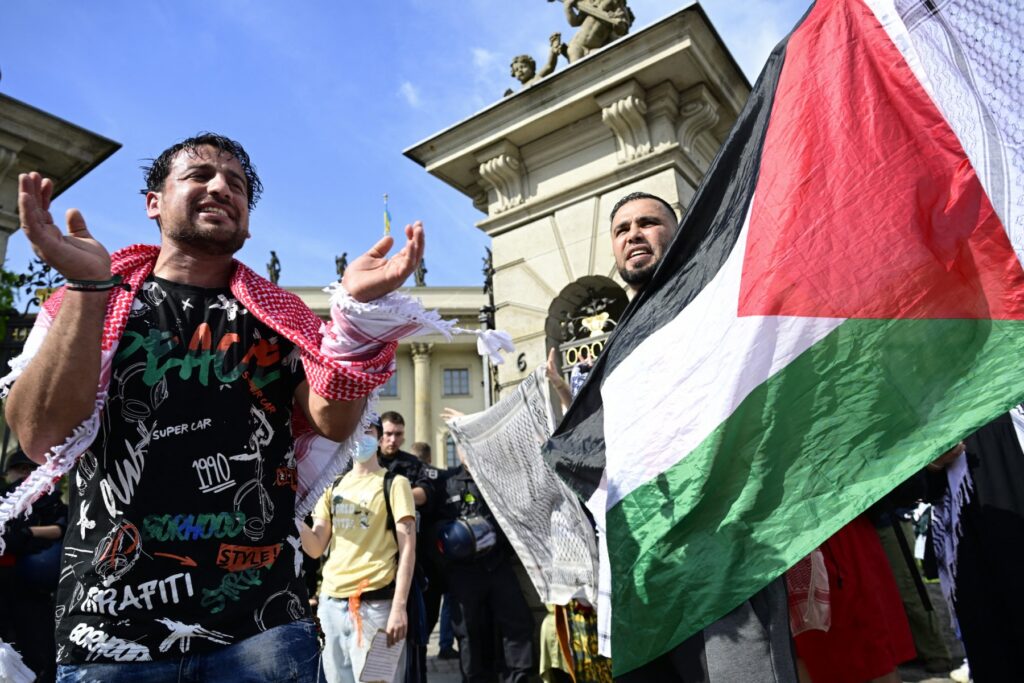
Demonstrators react and display the Palestinian flag as people staged a pro-Gaza sit-in in solidarity with the Palestinian people in front of Berlin's Humboldt University, on May 3, 2024. (Photo by JOHN MACDOUGALL / AFP)
In a historic shift, universities across Germany are witnessing a burgeoning wave of Palestinian solidarity, marking an unprecedented moment in the country’s academic landscape. This surge reflects a growing momentum among students and faculty to show support for Palestinian rights and to challenge established policies regarding Israeli academic collaborations.
The solidarity movement at German universities has gained notable traction despite the country’s government’s firm condemnation of the Boycott, Divestment, Sanctions (BDS) movement, which campaigns for Palestinian rights through economic and academic boycotts. German officials have expressed strong opposition to BDS, emphasizing Germany’s commitment to combating anti-Semitism and protecting the state of Israel.
Yet, the academic scene tells a different story. Increasingly, student groups and academic bodies are demanding their universities sever ties with Israeli institutions, viewing these partnerships as complicit in what they describe as Israel’s policies in Palestinian territories. Demonstrations, panel discussions, and petitions have become common on campuses from Berlin to Munich, spotlighting Palestinian narratives and advocating for academic independence from Israeli entities.
This rising call to cut institutional ties underscores a complex tension between Germany’s political stance and the growing activism within its academic institutions. Many university communities argue for the need to uphold academic freedom and solidarity with oppressed peoples, challenging the restrictive framework imposed by political condemnations of BDS.
Critics of this growing solidarity wave caution against actions that may blur the lines between legitimate political critique and anti-Semitism, a nuanced and sensitive issue in Germany given its historical context. However, activists involved stress that their movement centers on human rights and justice, not hostility toward Jewish individuals.
The phenomenon reflects broader global shifts, where university campuses have become fertile grounds for political activism and social justice movements. German universities, traditionally seen as bastions of critical thinking and democratic values, are now frontlines where debates over Palestine and Israel are intensely contested.
This historic wave also prompts Germany to reassess its approach to balancing its support for Israel with broader commitments to human rights and international academic cooperation. As calls escalate for more ethical and politically conscious university policies, the dialogue between government, academia, and civil society grows increasingly complex.
Overall, this surge in Palestinian solidarity at German universities signifies an important moment of change and reflection. It highlights the power of student voices in shaping academic and political discourse while underscoring the challenges of navigating contentious international issues within national contexts.