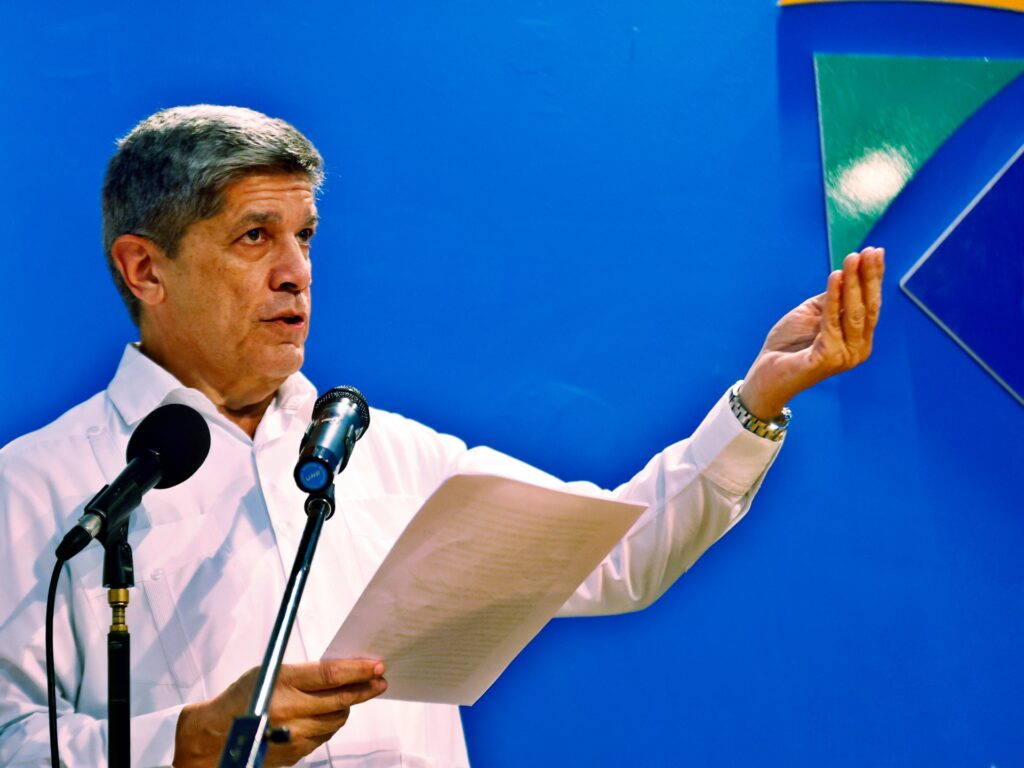
In recent discussions concerning US-Cuba relations, Cuba has made it unequivocally clear that it rejects any notion or suggestion of removing President Miguel Diaz-Canel as a condition in negotiations with the United States. Carlos Fernandez de Cossio, Cuba’s Minister of Foreign Affairs, has stated firmly that while they are open to engaging in talks about trade and other economic matters with the US, the sovereignty of their leadership is non-negotiable.
Cossio emphasized that Cuba is willing to discuss practical cooperation measures that could benefit both nations economically but refuses to entertain any proposals that involve leadership changes or political restructuring imposed by external entities. The minister’s remarks underscore Cuba’s stance on maintaining its political independence and rejecting what it perceives as foreign interference in its internal affairs.
The dialogue comes amidst longstanding tensions between Havana and Washington, which have been characterized by decades of embargoes, sanctions, and diplomatic standoffs. The US has repeatedly expressed willingness to engage Cuba on various fronts but has often linked improvements in relations to tangible political reforms in Cuban governance.
Cuba’s categorical rejection aligns with the government’s broader policy of defending its revolution and leadership structure, a legacy stemming from the 1959 Cuban Revolution and maintained through successive administrations. Diaz-Canel, who took office in 2018, represents continuity in Cuba’s socialist framework.
Trade discussions between the two countries could potentially open new avenues for economic engagement, providing some relief to Cuba’s struggling economy that has been hit hard by sanctions and the COVID-19 pandemic. Cuba sees trade as a pragmatic platform for dialogue without compromising its political principles.
Experts note that the Cuban government’s firm position on its leadership may complicate diplomatic breakthroughs but is consistent with its historical approach of prioritizing sovereignty over external pressures. Analysts suggest that while economic talks could progress, political negotiations may remain locked in a stalemate unless there is a fundamental shift in Washington’s approach.
The international community watches closely as these talks unfold, hoping for a de-escalation of tensions and the eventual normalization of US-Cuba relations. The outcome will likely influence broader geopolitical dynamics in the Caribbean region and beyond.
In summary, Cuba’s stance as articulated by Minister Carlos Fernandez de Cossio is clear: trade dialogue with the United States is on the table, but any attempt to push for the removal of President Diaz-Canel or interference in Cuba’s leadership is categorically unacceptable. This position highlights the enduring complexities in US-Cuba relations and sets the tone for future interactions between the two nations.