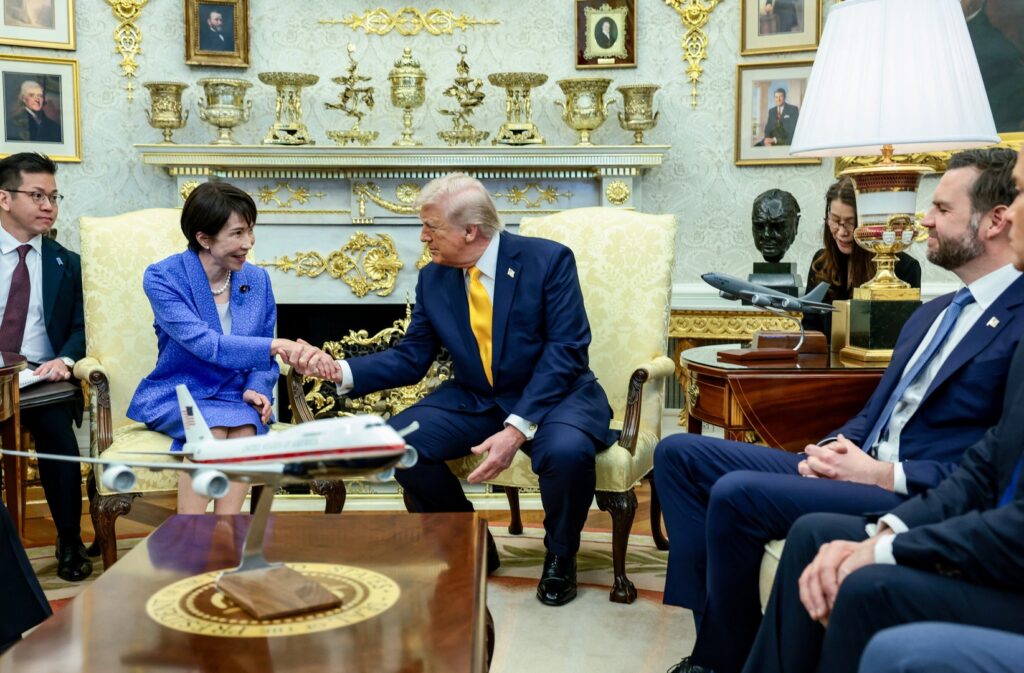
U.S. President Donald Trump shakes hands with Japanese Prime Minister Sanae Takaichi, with U.S. Vice President JD Vance sitting next to them, in the Oval Office at the White House in Washington, D.C., U.S., March 19, 2026. REUTERS/Evelyn Hockstein
In a surprising statement during a high-profile meeting with Japan’s Prime Minister Sanae Takaichi, former U.S. President Donald Trump drew a parallel between the recent strikes on Iran and the infamous attack on Pearl Harbor. This comparison has sparked significant attention and debate both in diplomatic circles and among global observers.
The meeting, which was intended to focus on strengthening bilateral ties and addressing key economic and security concerns, took an unexpected turn when Trump made the controversial analogy. His comparison of the Iran strikes to Pearl Harbor highlights the gravity with which he views the situation in the Middle East.
Pearl Harbor, the December 7, 1941, surprise military strike by the Japanese Navy Air Service against the United States naval base at Pearl Harbor, Hawaii, led to the U.S. entry into World War II. It is often regarded as a symbol of unexpected aggression and the need for decisive response.
By invoking this historical event, Trump seemed to suggest that the actions related to Iran could represent a similar level of threat or provoke a similarly significant reaction from the United States. Analysts note that such a statement may be intended to underscore the perceived seriousness of the conflict and the potential consequences of escalation.
Prime Minister Takaichi, caught off guard by the comparison, maintained composure but expressed the importance of careful deliberation to avoid further regional instability. Japan, heavily reliant on Middle Eastern oil exports and committed to international peace, is closely monitoring developments in the region.
The international community has varied reactions to Trump’s remarks. Some see the comparison as an effort to rally support for a stronger stance against Iran, while others warn that it risks inflaming tensions unnecessarily.
Experts caution that comparing current events to emotionally charged historical incidents can complicate diplomatic efforts and may hinder peaceful resolution. They emphasize the importance of contextual understanding and recommend measured approaches to conflict situations.
The strikes on Iran have been a focal point of global concern, involving complex geopolitical considerations, including U.S. foreign policy, Middle Eastern alliances, and global security.
Trump’s statement underscores the continuing impact of past leadership figures on current international affairs and the unpredictable nature of diplomatic discourse.
As Japan and the United States work together to navigate the consequences of recent events, dialogue remains crucial for maintaining stability and pursuing constructive solutions. Leaders will likely need to balance rhetoric with pragmatic strategies to address the challenges posed by the evolving situation in the Middle East.
This episode serves as a reminder of how historical memories and symbolic events remain influential in shaping contemporary political narratives and decisions around the world.