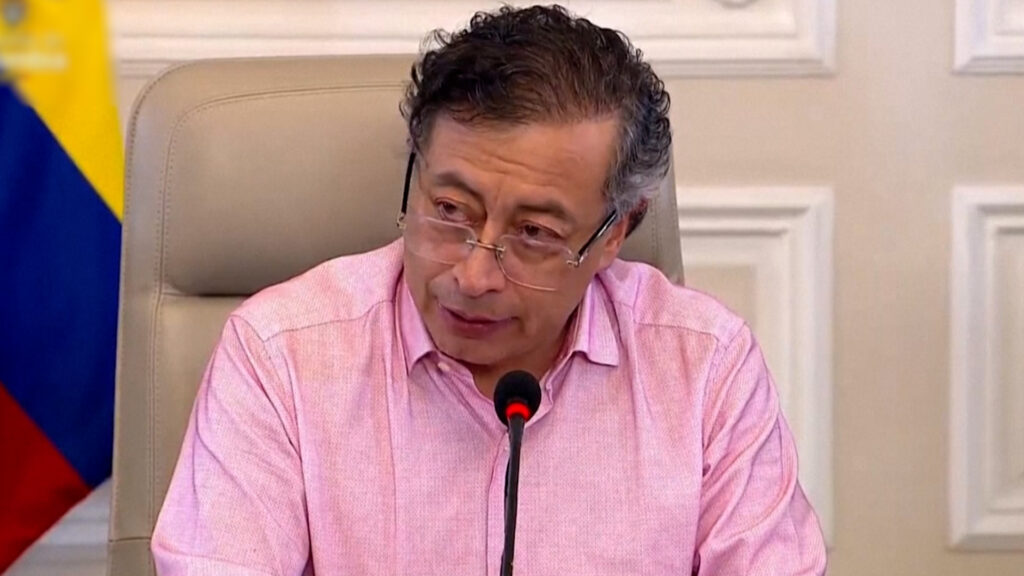
Colombian President Gustavo Petro has made striking remarks about the ongoing conflict in Gaza, describing the war as an “experiment” aimed at sending a broader message of intimidation to the Global South. Petro’s comments suggest that the violence and destruction in Gaza are not isolated incidents but part of a larger strategic maneuver.
In his statement, President Petro highlighted that the war in Gaza was engineered to serve as a demonstration — a sort of trial run — for potentially wider acts of destruction that could have far-reaching consequences beyond the immediate region. He emphasized that the conflict is being used deliberately to instill fear and assert control, particularly among nations in the Global South, which often feel marginalized or caught in the geopolitical crossfire.
This perspective from Petro adds a new dimension to the discourse surrounding the Gaza conflict, framing it not just as a localized territorial dispute or humanitarian crisis but as a calculated move with implications for international power dynamics. By referring to Gaza as an “experiment,” Petro argues that the scale and conduct of the violence could be testing the limits of global tolerance and the responses of international actors.
The Global South, a term generally used to describe developing countries in Africa, Latin America, Asia, and Oceania, often finds itself navigating complex political landscapes influenced by more powerful global players. Petro’s assertion raises concerns about how conflicts like Gaza’s can be used to suppress dissent, manipulate public opinion, and maintain a hierarchy favoring dominant powers.
Petro’s comments come amid ongoing debates about the ethics and consequences of foreign interventions, wartime conduct, and the use of military power as a tool of geopolitical strategy. His viewpoint aligns with broader critical analyses that view certain conflicts as instrumentalized by powerful entities to achieve broader goals.
The Colombian president’s remarks have reverberated through international media and political circles, prompting discussions on the need for greater scrutiny of the motivations behind wars and the impact these conflicts have on marginalized populations worldwide. Human rights advocates have long pointed out the disproportionate suffering endured by civilians in Gaza, while Petro’s framing calls attention to the strategic intentions that may underpin such suffering.
In summary, President Gustavo Petro’s characterization of the Gaza war as an experiment signals a warning about the potential for increased global destabilization resulting from the conflict. It challenges the international community to reconsider how it interprets and responds to wars that appear to serve larger strategic purposes, often at the expense of vulnerable populations in the Global South and beyond.