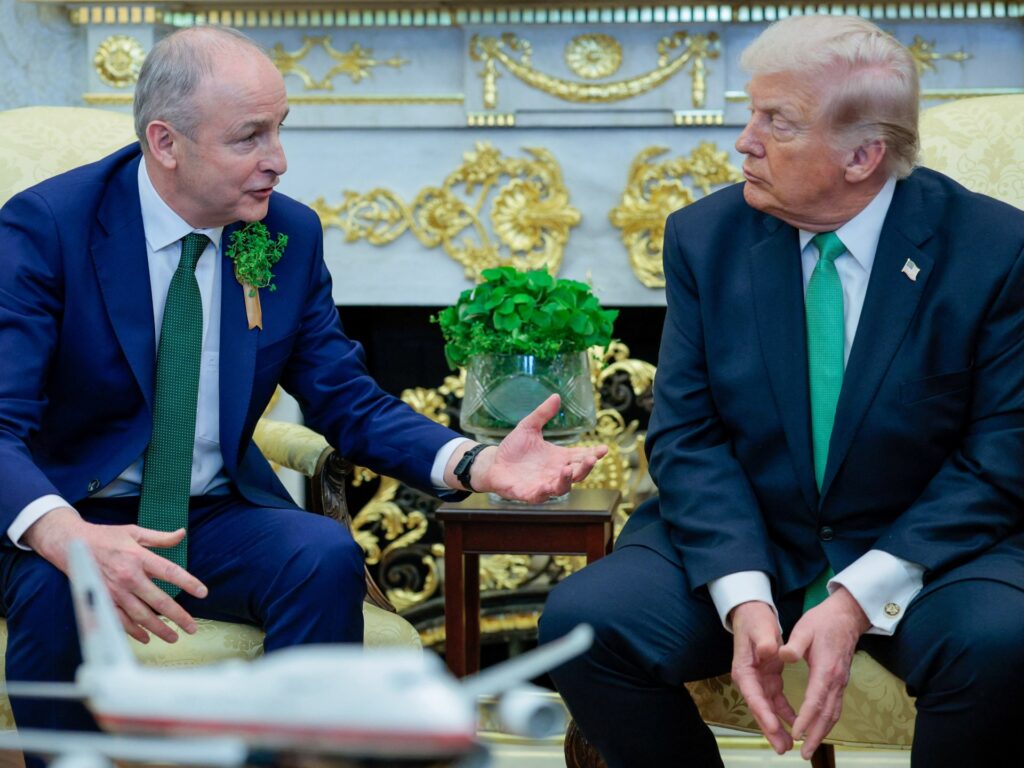
On a recent St Patrick’s Day event, Ireland’s former Taoiseach Micheal Martin found himself in an uncomfortable interaction with former U.S. President Donald Trump. The encounter was marked by an awkward exchange that drew public and media attention, highlighting the delicate interplay of diplomacy and public relations during significant cultural events.
Ireland has been notably vocal on major international issues, particularly its strong stance on the ongoing genocide in Gaza and its firm position regarding Iran. These stands underscore Ireland’s commitment to human rights and accountability on the global stage, and have shaped the country’s foreign policy in recent times.
Micheal Martin, however, has faced criticism at home for what some perceive as a passive approach to these international crises, especially given Ireland’s robust diplomatic posture. Critics argue that while the Irish government has made principled statements, there has been a lack of assertive action that matches its rhetoric.
The incident with Trump occurred during the annual St Patrick’s Day celebrations, which traditionally serve as a platform for Irish leaders to showcase their diplomatic skills and reinforce Ireland’s cultural and political messages worldwide. The awkward exchange contrasted sharply with the usual convivial atmosphere of these events, sparking discussions about the complexities Irish politicians face on the international stage.
Observers note that Ireland’s firm stance on Gaza and Iran reflects broader concerns about global justice and peace. The country has called for ceasefires, humanitarian aid, and diplomatic resolutions, positioning itself as a moral voice in international diplomacy.
Despite these efforts, tensions remain high, and the criticism of Martin’s perceived passivity suggests a desire among the public and political commentators for a more proactive and engaged Irish foreign policy. This sentiment reflects a broader expectation that Ireland should leverage its international relationships more effectively, especially with powerful nations like the United States.
Micheal Martin’s interaction with Donald Trump, who has himself been a controversial figure on various global issues, exemplifies the challenges Irish leaders face in navigating complex diplomatic landscapes. It highlights the sometimes unpredictable nature of international relations acting on symbolic occasions.
The clumsy exchange serves as a reminder of the importance of preparedness and skillful diplomacy, especially for smaller nations like Ireland seeking to assert their voice on the world stage. It also underscores how cultural events can unexpectedly become diplomatic flashpoints.
Looking ahead, analysts suggest that Ireland’s leadership must balance its moral imperatives with pragmatic diplomacy to ensure that its strong positions on issues like Gaza and Iran translate into meaningful influence and action.
In conclusion, the awkward St Patrick’s Day moment between Micheal Martin and Donald Trump has sparked a wider conversation about Ireland’s role in global politics, the expectations placed on its leaders, and the challenges of maintaining principled yet effective diplomacy in a complex and often volatile world environment.