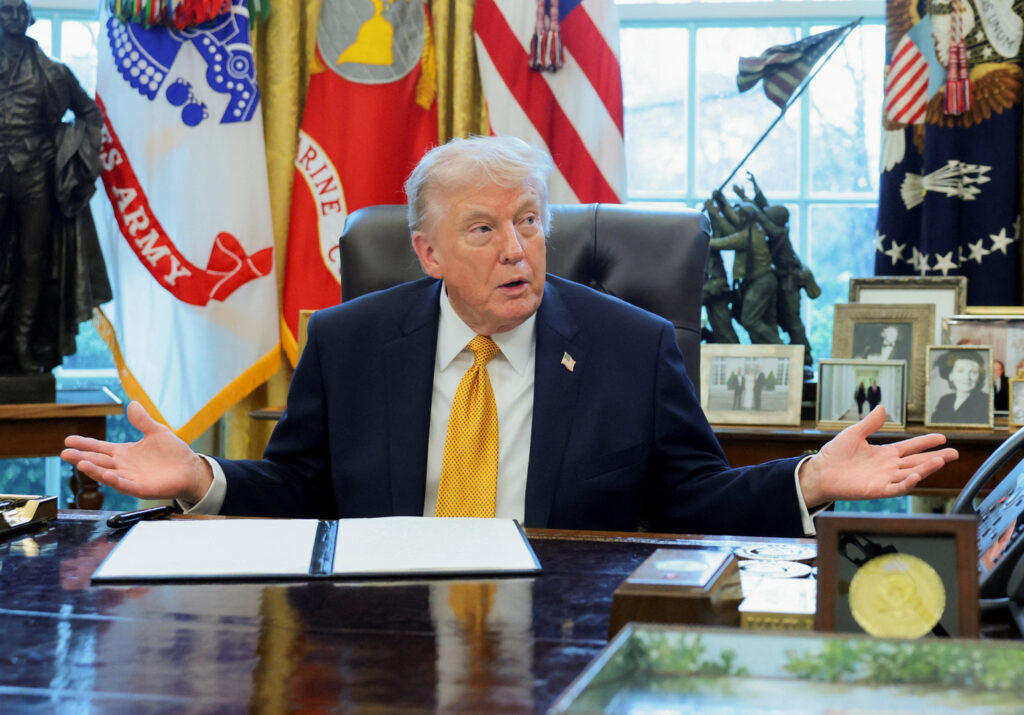
U.S. President Donald Trump speaks during an event to sign an executive order creating an anti‑fraud task force headed by U.S. Vice President JD Vance in the Oval Office at the White House in Washington, D.C., U.S., March 16, 2026. REUTERS/Jonathan Ernst
In a recent statement delivered at the Oval Office, US President Donald Trump described Somalia as a ‘fourth world nation,’ a phrase that has caught significant attention and stirred controversy. His remarks were part of a broader critique aimed at Somalia’s political and economic situation, as well as directed at Ilhan Omar, the Somali-American U.S. Congresswoman.
President Trump’s comments reflect longstanding concerns about Somalia’s challenges, including its ongoing struggles with instability, poverty, and governance. Somalia has faced decades of civil conflict, which has severely impacted its development and international standing. Despite numerous efforts by the global community and internal factions to promote peace and rebuild the country, Somalia still contends with many hardships that align with underdeveloped and conflict-affected nations.
The term ‘fourth world nation’ used by Trump is not a commonly accepted official classification, but it is often understood to highlight countries that are experiencing extreme poverty, lack of infrastructure, and ongoing conflict, placing them outside the traditional First, Second, and Third World categorizations.
Trump’s mention of Ilhan Omar, who fled Somalia as a child and later became a U.S. Congresswoman representing Minnesota, adds another layer to the statement. Omar has been a vocal advocate for immigrant rights and has often criticized U.S. foreign and domestic policies. The President’s remarks appear to criticize her background and political stance, which have been points of discussion in U.S. political and media circles.
Ilhan Omar’s critics argue that she is outspoken in ways that challenge traditional political norms, and she has often been at the center of political debates that address immigration, race, and foreign policy. Supporters, however, view her as a significant voice for underrepresented communities and progressive policies.
The reaction to Trump’s statements has been mixed, with some supporters applauding his candid approach to discussing international issues and others condemning the comments as insensitive and derogatory. Advocates for Somalia and its diaspora have expressed concern that such language perpetuates negative stereotypes and undermines efforts to support stability and development in the region.
Analysts highlight that the United States has strategic interests in Somalia and the broader Horn of Africa region, including counterterrorism efforts, economic partnerships, and regional security. The dialogue between U.S. officials and Somali leaders remains complex and multifaceted.
In summary, Trump’s comments on Somalia and Ilhan Omar have ignited a significant conversation about international relations, immigration, and the responsibilities of political leaders in fostering respectful discourse. As Somalia continues its path towards rebuilding and development, global partners, including the United States, face the challenge of balancing criticism with support.
The statement also underscores the broader political climate in the United States where immigration and identity politics remain deeply divisive subjects. As the debate unfolds, the implications for Somali Americans and the country of Somalia continue to develop, reflecting the interconnected nature of domestic and international politics.