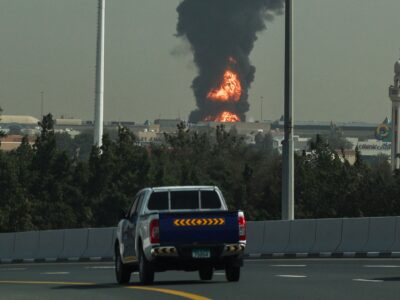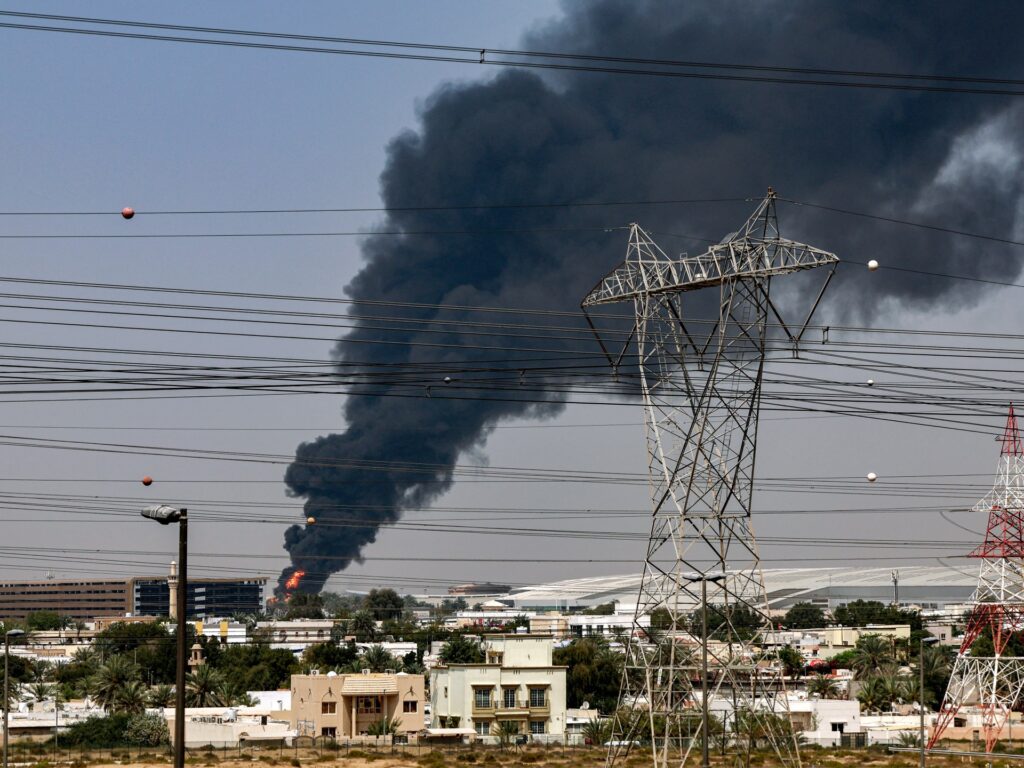
In a significant escalation in regional tensions, drone attacks have recently sparked fires near Dubai Airport and in the port city of Fujairah, two of the United Arab Emirates’ (UAE) vital hubs for international travel and commerce. These attacks have heightened concerns over security and stability in the Gulf region.
Sources report that the drone strikes caused notable damage and fires, disrupting operations and prompting emergency responses. Dubai Airport, one of the world’s busiest air transit points, and Fujairah, hosting critical oil storage and shipping facilities, are strategic sites, making these attacks highly consequential.
Iran’s Foreign Minister Abbas Araghchi addressed the situation amid rising international attention and tension. Speaking on the conflict, Araghchi clarified that Tehran has never sought a ceasefire agreement with the United States. This statement underscores Iran’s stance of preparing for a prolonged conflict rather than a quick resolution.
Araghchi’s remarks come amid longstanding disputes and hostilities between Iran and the US, particularly over issues such as nuclear capabilities, regional influence, and economic sanctions. The minister’s declaration signals Tehran’s readiness to endure and sustain pressure over an extended war period if necessary.
The recent drone strikes near Dubai and Fujairah are widely interpreted as part of a broader pattern of proxy conflicts and regional power struggles involving Iran, the US, and their allies. Analysts suggest that these attacks may be intended to signal Iran’s strategic capabilities and resolve without escalating to a full-scale war.
For the UAE, these attacks represent an alarming breach of regional security. Dubai and Fujairah are operational strongholds for commerce, tourism, and energy exports. Damage to these areas could have far-reaching economic repercussions not only locally but also globally, given the interconnected nature of energy markets.
International reactions have varied, with several countries condemning the attacks and calling for calm and dialogue. The US government has reiterated its commitment to safeguarding its partners in the region and maintaining freedom of navigation in international waters.
Experts warn that the drones’ use and the precision of the strikes indicate advanced operational capabilities and raise concerns about the proliferation of drone technology in conflict zones. This adds a new dimension to modern warfare, emphasizing asymmetrical tactics and technology-driven conflict.
The conflict and accompanying attacks emphasize the volatility of the Middle East region, where decades-old rivalries, sectarian divisions, and geopolitical competition fuel ongoing instability. The chance for peace seems slim as parties brace for a potentially extended period of unrest.
In summary, the recent drone attacks near Dubai Airport and Fujairah signify more than isolated incidents – they symbolize escalating tensions and the complex dynamics of Iran’s stance toward the US and its allies. Tehran’s explicit rejection of ceasefire talks and readiness for a prolonged war signal a challenging road ahead for regional diplomacy and security.
The global community remains watchful as the developments unfold, with hopes for eventual de-escalation and strategies to protect civilian infrastructure and preserve peace in the highly sensitive Gulf region.