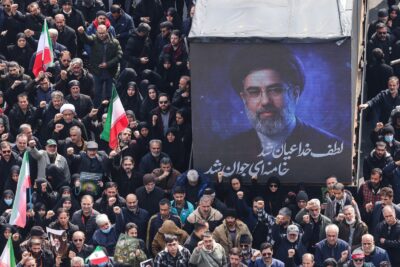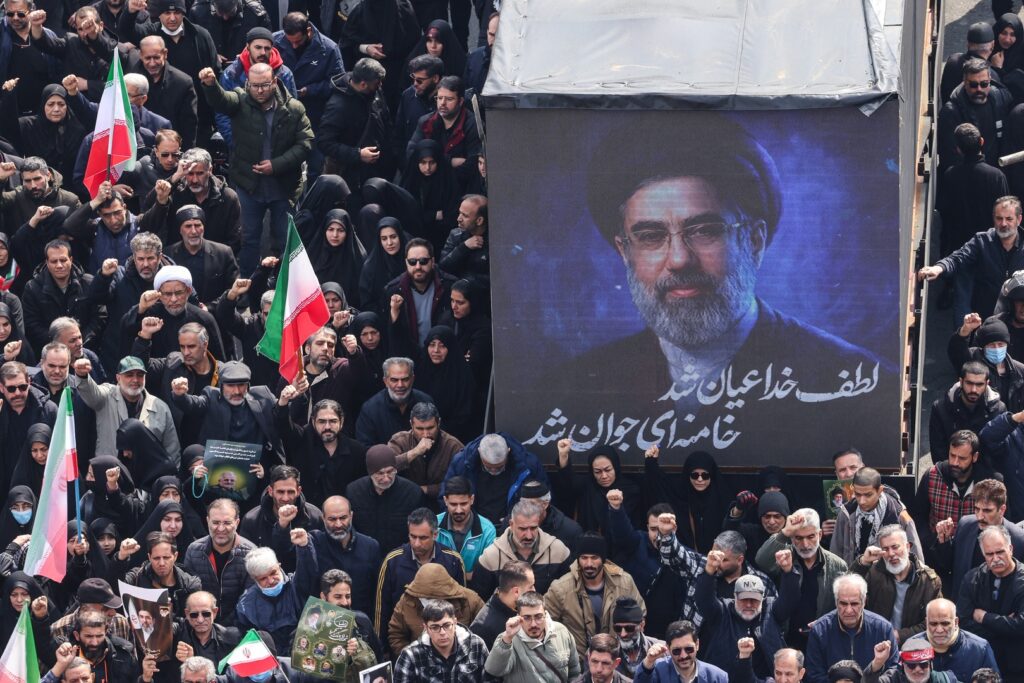
A screen displays a portrait of Iran's new supreme leader Mojtaba Khamenei during the funerals of Iran's Revolutionary Guards Corps (IRGC) commanders, army commanders and others killed in the early days of the United States and Israeli strikes on Iran, at Enghelab Square in Tehran on March 11, 2026. Washington launched strikes with Israel on Iran on February 28, sparking retaliatory strikes by Tehran against Israel and US bases across the Gulf region. (Photo by ATTA KENARE / AFP) / Attention editors: Photo taken with approval from the Ministry of Culture and Islamic Guidance (Ershad) -- AFP covers the war in the Middle East through its extensive regional network, including bureaus in Tehran, Jerusalem, and several neighboring countries. Since the start of the conflict, journalists have been working under increasingly restrictive conditions. Authorities in several countries have limited reporters' movements, photo and live video coverage from sensitive locations. Some governments and armed groups have banned images of missile or drone strikes and other security-related sites. /
Iran has a new Supreme Leader, Mojtaba Khamenei, who has recently stepped into this critical role following the appointment. His first official statement marks the beginning of a new chapter in Iran’s leadership and governance.
The appointment of Mojtaba Khamenei as Supreme Leader comes at a complex time for Iran, both domestically and on the international stage. His first remarks provide insight into his priorities and the direction he intends to steer the country.
In his inaugural statement, Mojtaba Khamenei emphasized the importance of unity among the Iranian people and the need to uphold the core values of the Islamic Republic. He spoke about maintaining Iran’s sovereignty and enhancing national security, which appear to be key pillars of his leadership agenda.
He also addressed external pressures faced by Iran, calling for resilience and self-sufficiency in the face of international sanctions and diplomatic challenges. This message resonates with recurring themes in Iranian policy, highlighting a commitment to resistance against external interference.
Domestically, the new Supreme Leader emphasized economic reforms aimed at strengthening Iran’s economy, boosting local production, and reducing dependency on foreign resources. He urged government institutions and citizens alike to work collaboratively towards these goals.
Mojtaba Khamenei also touched on social issues, reaffirming the importance of cultural values and the role of religion in society. He advocated for the preservation of Iran’s cultural heritage while pushing for progress in education and technology sectors.
His leadership style and policies will be closely watched, considering the impact the Supreme Leader has on Iran’s political framework and strategic decisions. Analysts expect that his tenure could influence the regional dynamics in the Middle East significantly.
The international community is also paying attention to his statements as indicators of Iran’s future foreign policy direction. His remarks suggest a continuation of a firm stance on regional matters but open the door for potential dialogue under specific conditions.
Citizens and political observers within Iran have responded with a mixture of cautious optimism and skepticism, reflecting the diverse views in the nation about the new leadership.
As Mojtaba Khamenei begins his tenure, the world watches closely to see how his vision for Iran unfolds, shaping the country’s path in the coming years. His first statement sets a tone of resolve and determination, signaling his intent to lead with a focus on strength, resilience, and national pride.
This development marks a significant moment in Iran’s history, with the potential to influence not just domestic affairs but also the broader geopolitical landscape of the region. The coming months will be crucial in understanding the full scope of his leadership and its implications for Iran and beyond.