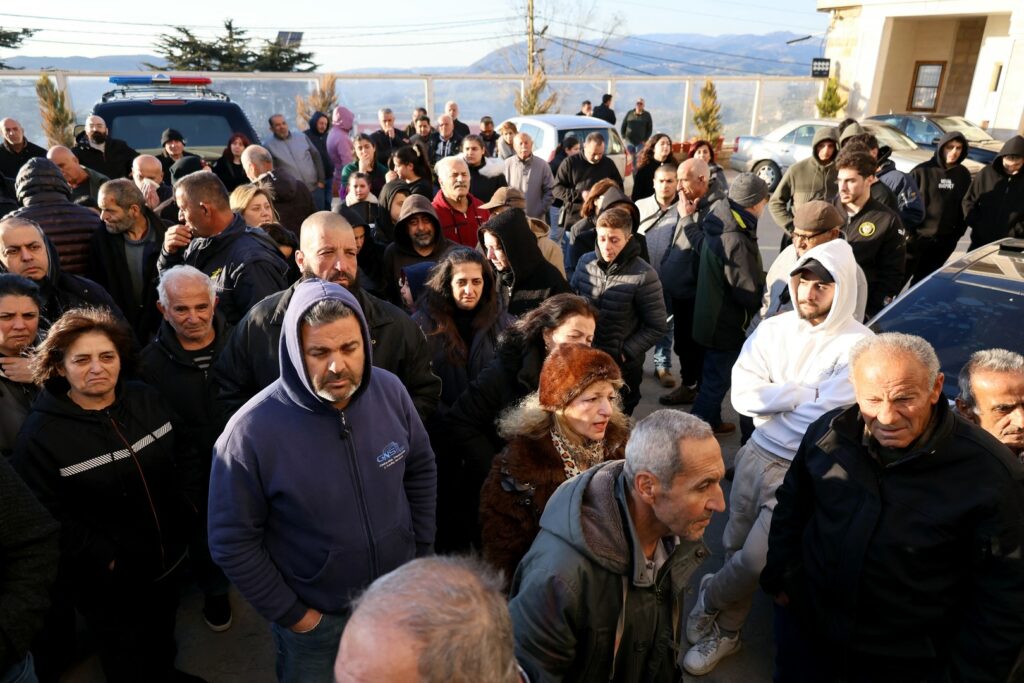
Residents gather outside the municipality hall to shows their anger for the death of the townís pastor by an Israeli shell that targeted his home, in the southern Lebanese border town of Al-Qlayaa on March 9, 2026. A south Lebanon parish lost its priest on March 9, when Father Pierre al-Rai of Al-Qlayaa died of wounds sustained from Israeli tank fire, according to state media and a medical source. On Friday, Rai had taken part in a gathering organised by locals in the neighbouring town of Marjayoun, where they said they were determined to remain in their homes despite evacuation warnings issued by the Israeli army to all residents south of the Litani river, about 30 kilometres from the border. (Photo by Rabih DAHER / AFP)
A tragic incident has unfolded in southern Lebanon where a Lebanese Maronite Catholic priest was killed by Israeli tank fire. The attack occurred when Israeli forces targeted a home in the region, resulting in the death of the priest. This event adds to the ongoing tensions and violence in the area, where Israeli military actions have frequently sparked conflict with Lebanese communities.
The Maronite Catholic Church, a significant Christian denomination in Lebanon, has expressed deep sorrow over the loss of the priest, who was respected in his community. The incident highlights the dangers faced by civilians and religious figures amidst military confrontations in this volatile region.
Israeli tank fire targeting civilian homes often leads to casualties and destruction, further escalating hostilities between Lebanon and Israel. The international community has called for restraint and the protection of non-combatants, emphasizing the importance of adhering to international humanitarian law during conflicts.
This latest casualty is likely to inflame sentiments in Lebanon, where the memory of previous conflicts with Israel remains strong. It also raises concerns about the ongoing security situation along the Israel-Lebanon border, which has seen sporadic violence and military exchanges.
The death of the priest underscores the human cost of the conflict and the urgent need for diplomatic efforts to achieve peace and stability in the region. Both sides have historically blamed each other for provocations, but incidents such as this highlight the tragic consequences for innocent people caught in the crossfire.
Lebanese authorities are expected to investigate the circumstances of the attack and call for accountability. The church and local communities are mourning the loss and calling for support and protection to prevent further tragedies.
This event serves as a reminder of the fragile state of peace in the Middle East and the ongoing struggles faced by communities living in conflict zones. It stresses the importance of dialogue, negotiation, and respect for human life to break the cycle of violence.
As the region watches closely, the hope remains for a cessation of hostilities and a move towards a more peaceful coexistence, where such tragedies no longer occur. The global community’s engagement in peaceful conflict resolution and humanitarian aid remains crucial to support Lebanon and its people during such difficult times.