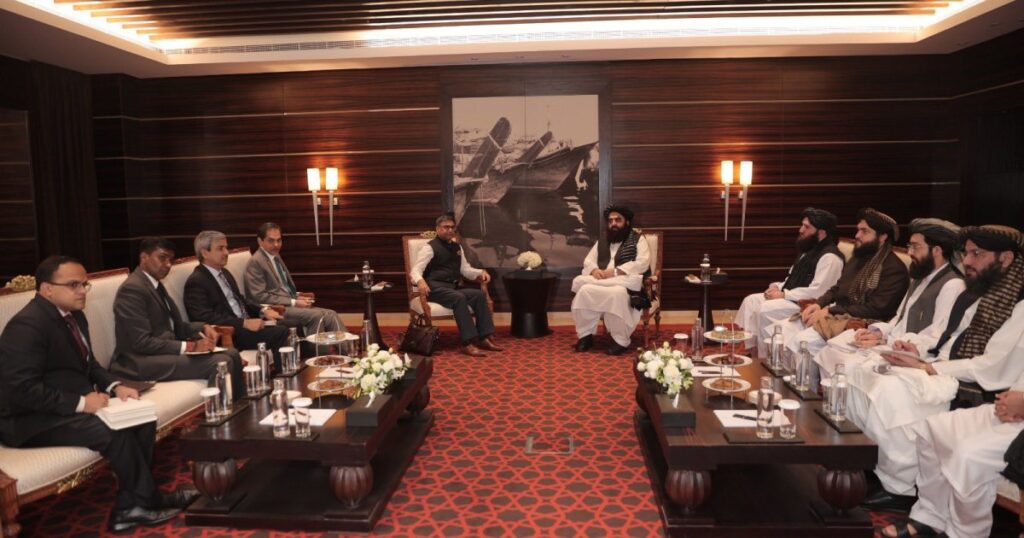
India’s influence in Afghanistan has been a subject of intense debate, especially in the context of the Taliban’s return to power in 2021. Despite Pakistan’s allegations that Afghanistan has become ‘a colony of India,’ the relationship between India and Afghanistan spans several decades, far preceding the Taliban’s latest regime.
Historically, India has maintained strong ties with the Afghan government and people, rooted in shared cultural, historical, and strategic interests. India’s involvement in Afghanistan has been multifaceted, including extensive development projects, humanitarian aid, educational scholarships, and diplomatic engagement.
Under Taliban rule, India’s approach has been cautious but persistent. While India does not officially recognize the Taliban government, it continues to engage indirectly through diplomatic channels and international forums. India has focused on protecting its investments in Afghan infrastructure, health care, and education, reflecting its long-term strategic interest in the region’s stability.
Pakistan’s accusation that Afghanistan has become ‘a colony of India’ stems from geopolitical rivalry, with Islamabad perceiving India’s presence as a threat to its own strategic interests, particularly concerning influence in the Pashtun-dominated regions and counterterrorism issues. However, these claims are often viewed as part of the broader India-Pakistan competition for regional dominance.
India’s historical aid to Afghanistan includes projects such as the construction of the Afghan parliament building, road networks like the Delaram-Zaranj highway, and numerous schools and hospitals. Afghan citizens have predominantly viewed India’s contribution positively, appreciating its role in reconstruction and development efforts.
Since the Taliban takeover, India has been reluctant to resume all its projects but remains committed to humanitarian support. It has offered assistance for COVID-19 relief and continues to provide educational scholarships to Afghan students, emphasizing people-to-people connections over official state recognition.
Despite the complex political landscape, India’s influence in Afghanistan persists through cultural diplomacy, infrastructural projects, and humanitarian efforts. This influence reflects India’s strategic vision of a stable Afghanistan that can act as a buffer against extremism and support regional connectivity.
In contrast, Pakistan’s relationship with the Taliban has been more direct, including allegations of support and safe havens for insurgent groups, which complicates the regional security dynamics.
The evolving situation requires a nuanced understanding of India’s role in Afghanistan, moving beyond simplistic accusations. India’s enduring engagement reflects a combination of altruistic development aid and pragmatic geopolitical considerations.
Experts suggest that India’s influence in Afghanistan is less about dominance and more about fostering partnership and stability in a historically volatile region. While Pakistan views India’s presence with suspicion, Afghan public opinion and civil society voices often highlight India’s positive contributions.
In conclusion, India’s influence in Afghanistan under Taliban rule has not disappeared but transformed, focusing more on humanitarian and soft power strategies rather than direct political involvement. This approach aligns with India’s long-standing policy of fostering peace and development in Afghanistan, emphasizing a future of cooperation over conflict.