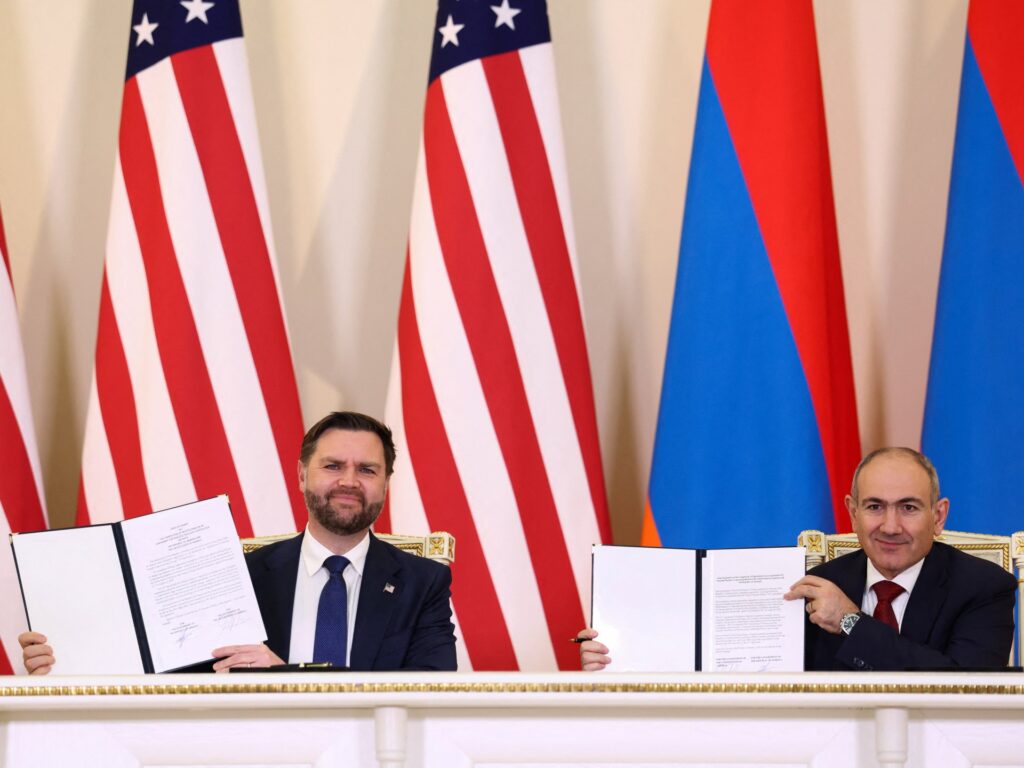
In a significant geopolitical development, the United States has reached a civil nuclear agreement with Armenia, a country traditionally regarded as a close ally of Russia. This move reflects the shifting dynamics in international relations and showcases the US’s efforts to strengthen ties with countries in the Eurasian region.
During a visit to Armenia, US Vice President JD Vance announced the agreement, underscoring Washington’s commitment to expanding its influence in the region. Vance highlighted the strategic importance of the partnership, which is expected to enhance Armenia’s energy capabilities through the development of civilian nuclear technology.
As part of the agreement, the US pledged up to $9 billion in potential investment to support Armenia’s civil nuclear sector and broader economic development. This substantial financial commitment aims to modernize Armenia’s energy infrastructure, boost economic growth, and reduce the country’s dependence on Russian energy supplies.
The deal marks a notable pivot for Armenia, which has long relied on close ties with Russia for military and economic support. By diversifying its international partnerships and embracing US investment, Armenia signals a desire to balance its foreign relations and strengthen its sovereignty in the face of regional challenges.
Experts view the agreement as part of a broader US strategy to counter Russia’s influence in Eurasia. By building stronger economic and technological links with countries like Armenia, the US hopes to establish a foothold in the region’s energy domain and promote democratic governance and stability.
The civil nuclear agreement will involve the transfer of advanced nuclear technology and the establishment of safety protocols aligned with international standards. It will enable Armenia to upgrade its nuclear facilities and potentially expand its electricity generation capacity, addressing energy security concerns.
Vance’s visit included discussions on trade, security cooperation, and regional stability. The US also expressed support for Armenia’s sovereignty and territorial integrity amid ongoing tensions in the South Caucasus.
The announcement was met with mixed reactions. While many in Armenia welcomed the deal as a pathway to economic modernization and reduced energy vulnerability, some voices expressed concern over potential geopolitical repercussions and the risks associated with nuclear energy.
Russian officials have yet to comment extensively on the agreement, but analysts suggest that Moscow may view the US-Armenia deal as a challenge to its traditional sphere of influence. This development could prompt Moscow to reassess its policy options in the South Caucasus.
In summary, the US civil nuclear agreement with Armenia marks a major milestone in US-Armenian relations and signals a shift in the geopolitical landscape of the region. With significant investment and technology transfer on the horizon, Armenia is poised to enhance its energy independence while navigating complex regional dynamics. This partnership may serve as a blueprint for future US engagement in Eurasia, emphasizing civil nuclear cooperation as a key component of strategic diplomacy.