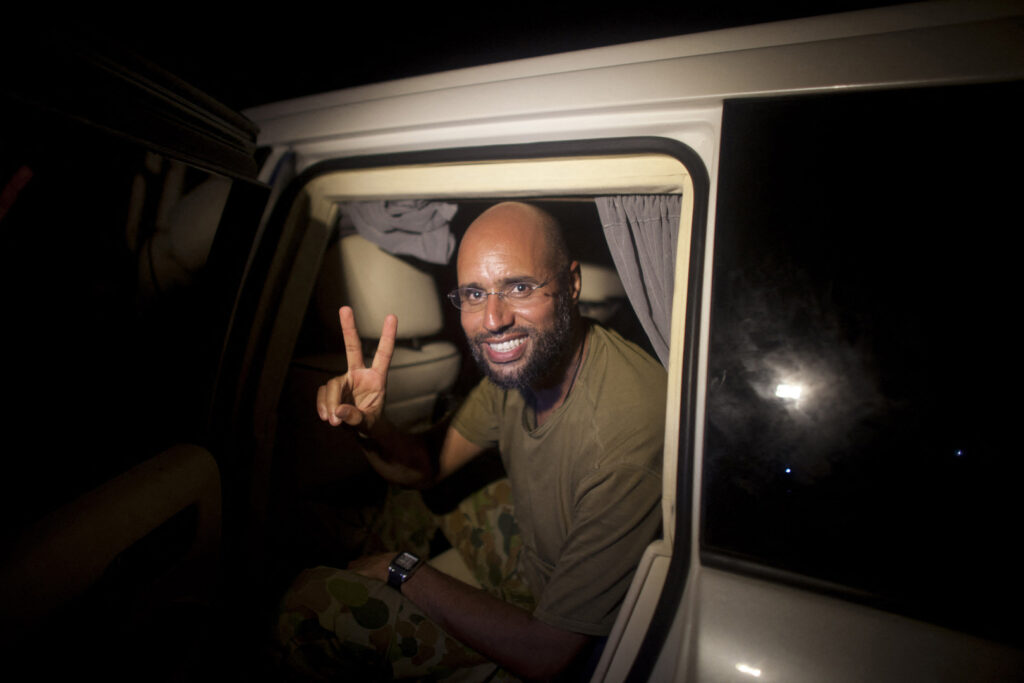
Saif al-Islam Kadhafi, son of Libyan leader Moamer Kadhafi, flashes the V-sign for victory as he appears in front of supporters and journalists in the Libyan capital Tripoli in the early hours of August 23, 2011. Seif al-Islam, wanted by the International Criminal Court for crimes against humanity and who ICC prosecutor Luis Moreno-Ocampo earlier said had been arrested by the rebels, claimed the insurgents had suffered "heavy casualties" when they stormed Kadhafi's Bab al-Azizya compound in Tripoli. AFP PHOTO/ POOL / Dario Lopez-Mills (Photo by DARIO LOPEZ-MILLS / POOL / AFP)
Saif al-Islam Gaddafi, the son of former Libyan leader Muammar Gaddafi, was recently killed in a brutal and treacherous assassination reportedly carried out by “four masked men.” The news has sent shockwaves through Libya and the international community, prompting many to revisit the life and legacy of this controversial figure.
Born in 1972, Saif al-Islam was the second son of Muammar Gaddafi, who ruled Libya for over four decades until his ousting and death during the Libyan civil war in 2011. Saif was seen as the face of reform within the Gaddafi regime, often representing Libya on the international stage and advocating for modernization and economic development. Educated in the West, he held a PhD from the London School of Economics and was considered by some as a potential successor to his father.
Despite his reformist image, Saif al-Islam was a highly polarizing figure. During the 2011 uprising that led to the fall of Gaddafi’s regime, he was accused of orchestrating violent crackdowns against protesters and rebels. After the regime’s collapse, Saif went into hiding and was captured by local militias. Although sentenced to death in absentia, he was later released, reflecting the complicated and fragmented political landscape of post-Gaddafi Libya.
Saif’s death by four masked assailants exemplifies the ongoing instability and factional violence that continue to plague Libya. Since the fall of Muammar Gaddafi, the country has been fragmented among rival militias, tribal factions, and political groups, making the path to peace and reconstruction uncertain.
The assassination marks the end of an era and raises urgent questions about Libya’s future. Who orchestrated the killing remains unclear, but it highlights the dangerous power struggles shaping the nation’s destiny. Saif al-Islam Gaddafi’s life and death encapsulate the promise and peril of a country still grappling with its post-revolution identity and the challenge of building lasting peace and stability.
In conclusion, Saif al-Islam Gaddafi was a figure of complexity, caught between reform and repression, legacy and upheaval. His assassination by masked gunmen is a stark reminder of the treacherous political terrain in Libya — a terrain still marked by conflict, uncertainty, and the hope for eventual reconciliation.