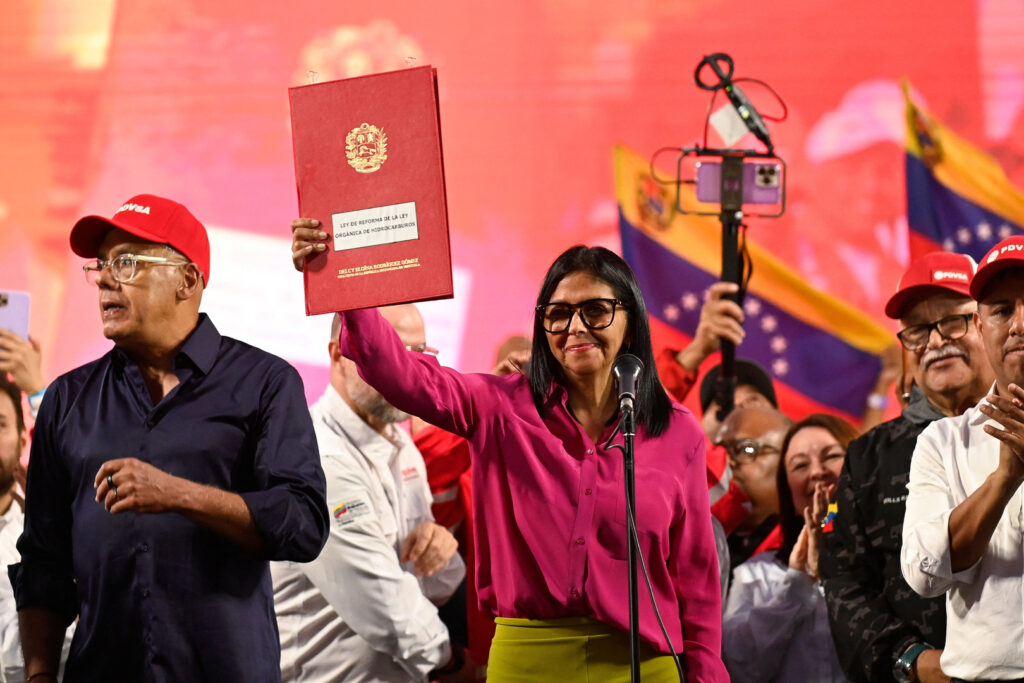
Venezuela's interim President Delcy Rodriguez takes part in a gathering in support of reforming the country's main oil law and the release of ousted President Nicolas Maduro and his wife, Cilia Flores, in Caracas, Venezuela, January 29, 2026. REUTERS/Maxwell Briceno
In a significant move signaling a potential shift in the geopolitical and economic landscape of Latin America, Venezuela’s interim President Delcy Rodriguez has signed into law a reform bill aimed at opening up the nation’s oil industry to international investors and partners. This legislative transformation comes at a pivotal time when the United States has begun easing its sanctions against Venezuela, marking a thaw in relations that could reshape the country’s access to global markets.
Venezuela, known for having some of the largest proven oil reserves in the world, has historically maintained tight government control over its oil sector. This move to reform the sector is designed to attract foreign investment, improve oil production capacity, and rejuvenate an industry that has suffered from years of underinvestment, political turmoil, and international isolation.
The new law allows foreign companies to enter into joint ventures and production-sharing agreements with Venezuela’s state-owned oil company, Petróleos de Venezuela, S.A. (PDVSA), lifting previous restrictions that limited the role of international partners. This shift is expected to bring much-needed capital, technology, and expertise to revive Venezuela’s oil output, which has declined steeply in recent years.
President Rodriguez’s decision to sign this reform bill comes amid a broader strategy to stabilize the country’s economy and re-establish its presence in global energy markets. The reform is also seen as a response to the easing of US sanctions, which have long restricted Venezuela’s ability to engage with international companies and sell its oil abroad.
The US sanctions on Venezuela, imposed during the previous administration due to concerns over human rights and democratic governance, have significantly impacted the country’s oil exports and economic health. Recent diplomatic engagements have led to a softening of these measures, paving the way for Venezuela to seek new partnerships and boost its oil revenues.
Industry analysts warn that despite these promising steps, Venezuela still faces significant challenges, including political instability, economic hardships, and the need to rebuild a trustful relationship with the international community. The success of the oil sector reform will largely depend on the government’s ability to implement transparent policies and provide an environment conducive to foreign investment.
Moreover, the opening of the oil sector has implications beyond economics. It could potentially influence regional energy dynamics, impact global oil prices, and play a role in discussions about energy transition and sustainability.
Environmental groups and activists have expressed concerns over increased foreign involvement in Venezuela’s oil industry, urging that any development should consider ecological impacts and the shift towards greener energy sources.
In summary, Venezuela’s new oil reform law and the easing of US sanctions mark a crucial juncture for the South American nation. This development holds promise for economic recovery and growth, while also highlighting the complexities and challenges of navigating international politics and market forces in a rapidly changing global energy landscape.