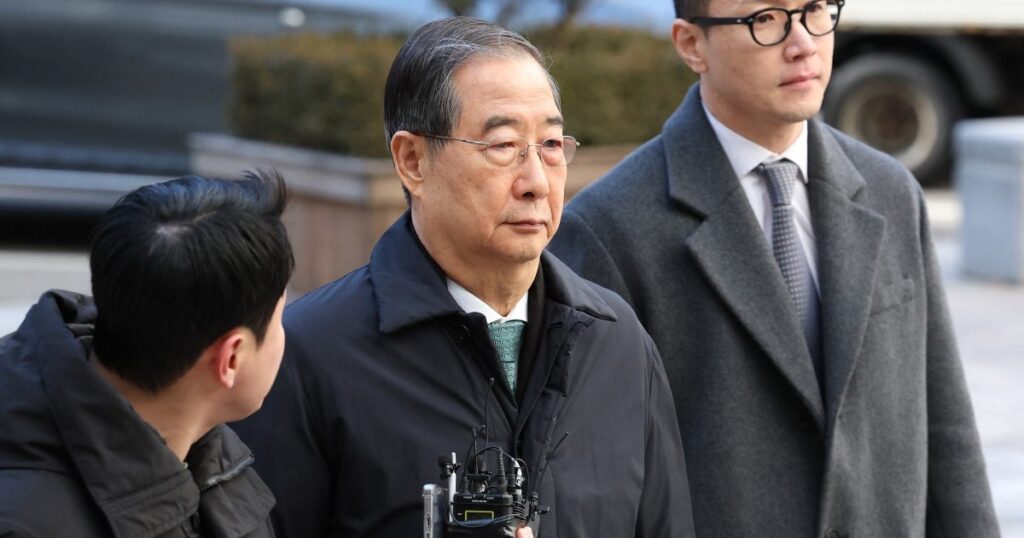
In a landmark ruling, South Korea’s former Prime Minister Han Duck-soo has been found guilty of insurrection and sentenced to 23 years in prison. The court’s decision centers on accusations that Han failed to hold a lawful cabinet meeting following the declaration of martial law.
The case has drawn significant attention to the legal and constitutional responsibilities of government officials during times of national emergency. The indictment claimed that Han’s actions, or lack thereof, undermined lawful governance and contributed to an unconstitutional exercise of power.
Han Duck-soo, who held the office of Prime Minister during a tumultuous period, was expected to uphold strict procedural standards after martial law was announced. However, the prosecution argued that he neglected these duties by not convening the cabinet meetings required by law, allowing martial law to be enforced improperly.
The court found that this failure amounted to insurrection, a charge that carries serious penalties given the potential threat to democratic order. The 23-year sentence reflects the gravity of the offense as determined by the judiciary.
Legal experts note that this verdict sets a precedent in South Korea for holding high-ranking officials accountable in situations where constitutional norms are at risk. It underscores the judiciary’s role in safeguarding democratic institutions against abuses of power.
The declaration of martial law is a measure reserved for extreme circumstances, typically to restore public order during crises such as widespread unrest or external threats. In this case, Han’s alleged non-compliance with legal procedures during its imposition has been deemed an affront to the rule of law.
Political analysts observe that the ruling may have lasting implications on how government executives operate under martial law conditions hereafter. It serves as a stern reminder that adherence to constitutional norms is non-negotiable, even amidst emergencies.
Public reaction to the verdict has been mixed, reflecting South Korea’s varied political landscape. Some view the sentence as a necessary step toward justice and upholding democratic principles, while others see it as a harsh punishment that may polarize opinion further.
Han Duck-soo’s legal team has signaled an intention to appeal the decision, arguing that the charge of insurrection is disproportionate and that procedural lapses do not equate to criminal intent.
The judiciary’s firm stance, however, highlights an unequivocal commitment to enforcing the law impartially and maintaining the constitutional order. The trial and its outcome are likely to be studied extensively as a case of legal accountability in governance.
Moreover, this development adds a significant chapter to South Korea’s political history, where former leaders are scrutinized for their roles during critical junctures. The ruling could influence how future governmental responses to crises are managed, with an increased emphasis on legality and transparency.
Experts also stress the importance of institutional checks and balances to prevent any recurrence of such failures in government conduct during emergency measures. Strengthening oversight mechanisms may become a policy priority moving forward.
The government has yet to issue an official statement on the sentence, but it is expected to take measures to reinforce the legal frameworks that guide martial law enforcement.
Overall, the conviction of Han Duck-soo marks a pivotal moment for South Korean democracy, emphasizing the inviolability of constitutional procedures and the rule of law, irrespective of political stature or circumstance.