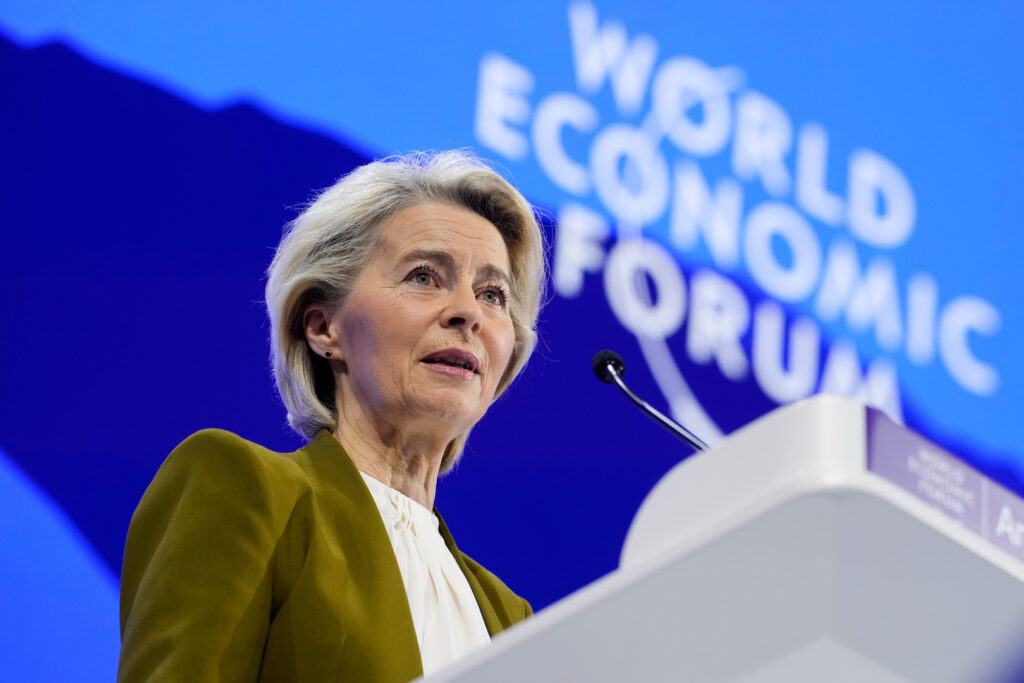
President of the European Commission Ursula von der Leyen talks during the Annual Meeting of the World Economic Forum in Davos, Switzerland, Tuesday, Jan. 20, 2026. (AP Photo/Markus Schreiber)
At the World Economic Forum in Davos, European Union chief Ursula von der Leyen sharply criticized former US President Donald Trump’s proposal to impose tariffs on Greenland, raising concerns about the reliability of his trade commitments. Von der Leyen emphasized that ‘a deal is a deal,’ underscoring the importance of honoring international agreements and expressing frustration over the unpredictability of Trump’s trade policies.
This confrontation adds to the growing tensions between the EU and the US regarding trade disputes and protectionist measures introduced during Trump’s administration. The proposed tariffs on Greenland, a strategic Arctic territory, stirred controversy due to their potential geopolitical and economic implications.
Greenland, while an autonomous Danish territory, holds significant value because of its natural resources and location. Trump’s tariffs were seen by many as an aggressive move that could destabilize established partnerships and economic relations in the region.
The controversy deepened as von der Leyen publicly questioned Trump’s trustworthiness in maintaining consistent and transparent trade negotiations. This skepticism reflects broader concerns among EU leaders about the unpredictability of US trade policies under Trump, which they say could undermine global economic stability.
The EU is committed to defending its trade interests and ensuring that agreements are respected. Ursula von der Leyen’s remarks at Davos signal a stronger stance against unilateral protectionist policies that disrupt established international trade frameworks.
Critics of the tariffs argue that these measures not only threaten economic cooperation but also risk politicizing trade relations, which traditionally have been built on mutual benefit and respect. The EU’s response highlights its dedication to multilateralism and cooperative economic diplomacy.
This episode at Davos serves as a reminder of the fragile nature of international trade agreements in a changing global political landscape. The EU’s outspoken defense of Greenland’s trade status could have lasting impacts on transatlantic relations and future negotiations.
As leaders continue to debate the balance between national interests and global cooperation, the Greenland tariffs incident underscores the ongoing challenge of maintaining trust between major economic powers. The EU’s call for adherence to agreed terms reaffirms its role as a defender of stable and predictable international trade.
In conclusion, Ursula von der Leyen’s critique of Donald Trump’s Greenland tariffs during the Davos summit highlights the tensions over trade trustworthiness and the importance of upholding commitments. This development is a significant chapter in the evolving story of EU-US economic relations and the global dialogue on trade fairness.