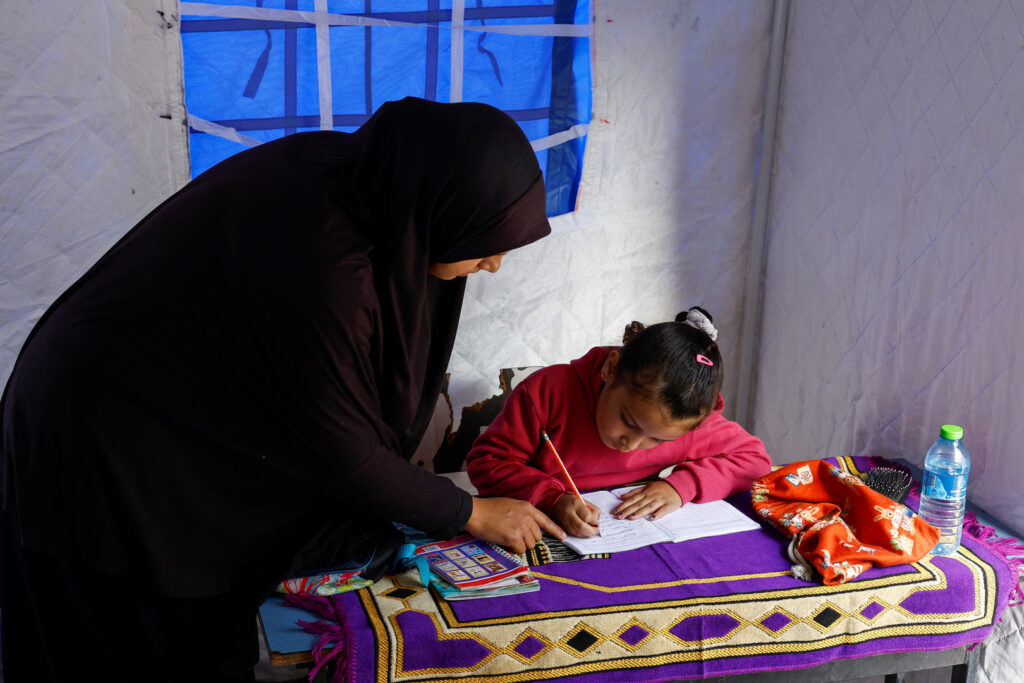
Displaced Palestinian mother, Yasmine Al-Aajouri, helps her seven-year-old daughter Toulin Al-Hindi with her homework inside their tent near the Israeli-designated "yellow line", in Beit Lahiya, northern Gaza Strip, January 6, 2026. REUTERS/Mahmoud Issa
In the northern Gaza Strip, seven-year-old Toulin Al-Hindi and many other children face perilous conditions just to attend school. Their classrooms are tents pitched close to what is known as Israel’s ‘yellow line,’ a heavily militarized boundary. These children study under constant threat as gunfire and sniper activity are a regular occurrence, making the pursuit of education a daily challenge fraught with danger.
The ongoing conflict has forced many schools in Gaza to operate in temporary, fragile settings, with tents providing the only available space for education. Within these tented schools, teachers and students strive to maintain a semblance of normalcy despite the sounds of explosions and gunfire outside. Toulin and her peers walk daily through hazardous paths, risking sniper fire to reach their classrooms.
The ‘yellow line’ refers to a boundary along the Gaza-Israel border which has seen numerous escalations in violence. It is named for the yellow-colored fence that demarcates the border area. Snipers stationed nearby frequently target individuals crossing or approaching this zone, creating a lethal environment. This reality imposes severe limitations on the freedom and safety of Gaza’s residents, particularly children.
International humanitarian organizations have repeatedly expressed concern over the usage of tents for schools in such high-risk zones. They emphasize the need for safer, permanent educational facilities to protect children’s rights and ensure uninterrupted access to education. Local authorities and aid groups are working under difficult conditions to provide educational resources, including textbooks, supplies, and psychological support to help children cope with the stress of living in conflict zones.
Toulin’s story reflects the broader plight of Gaza’s children whose education and childhoods are overshadowed by ongoing conflict. Despite the hardships, the resilience shown by these young students and their educators is remarkable. Their determination to learn amid gunfire is a powerful reminder of the human cost of conflict and the urgent need for peaceful resolution.
Efforts to improve the situation include international calls for ceasefires, increased humanitarian aid, and diplomatic interventions to reduce violence along the boundary. Advocacy groups stress that education in Gaza must be safeguarded as a fundamental right, and children must not be subjected to education under threat of violence.
As Toulin studies each day in her tent near the ‘yellow line,’ her courage highlights the hope for a future where children in Gaza can attend schools safely, without fear, and where education can be a tool for peace rather than a battleground. The community and global actors alike watch with hope that one day, the sound of learning will replace the sound of gunfire along this volatile border.