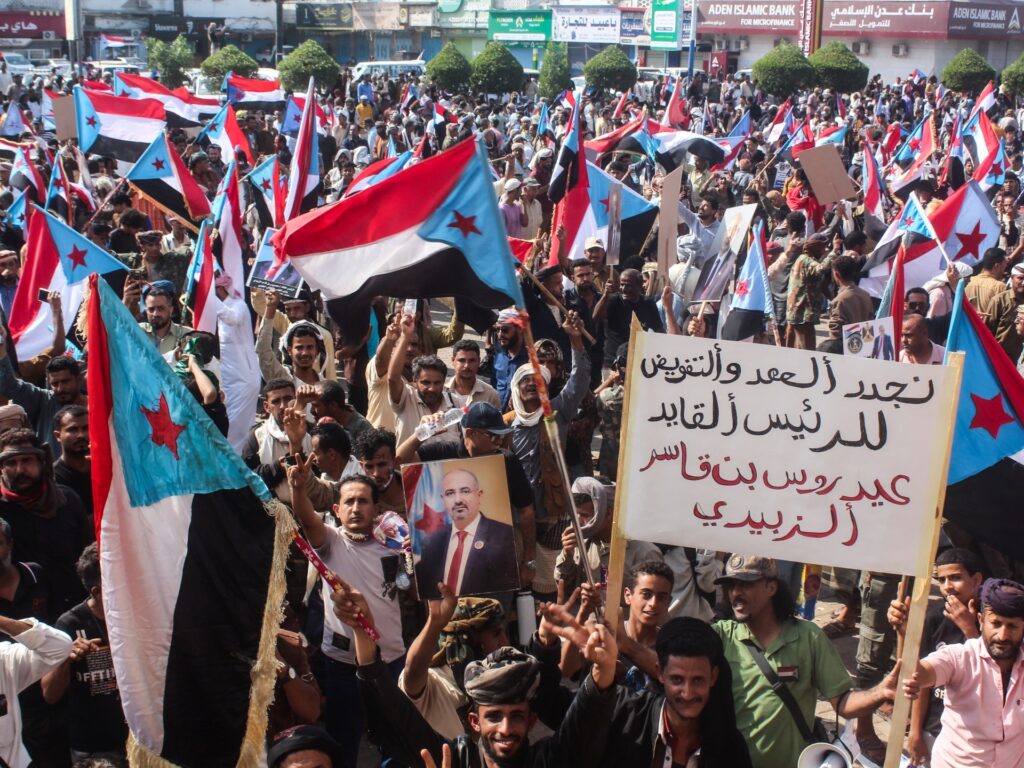
The Yemeni government has announced the successful recapture of key southern areas previously controlled by the Southern Transitional Council (STC). Rashad al-Alimi, a prominent government official, confirmed that government forces have regained control over the Hadramout and al-Mahra provinces, marking a significant shift in the ongoing conflict in Yemen.
The Southern Transitional Council, which has been a major separatist faction in Yemen, had established control over these regions amidst the country’s prolonged civil war. The reclaiming of Hadramout and al-Mahra is seen as a strategic victory for the Yemeni government, as it aims to restore national unity and stabilize the southern parts of the country.
Hadramout and al-Mahra are critical provinces due to their geographic and economic importance. Hadramout is the largest governorate in Yemen by area and has substantial oil and gas reserves. Al-Mahra, located along the eastern coast, is strategically important for maritime routes and has a diverse population with longstanding local dynamics.
The conflict between the Yemeni government and the STC has been a significant component of Yemen’s multifaceted civil war. The STC, which seeks autonomy or independence for southern Yemen, broke away from the internationally recognized government and has received varying degrees of support from different regional actors.
Rashad al-Alimi’s announcement underscores the Yemeni government’s commitment to reclaim sovereignty and challenge the separatist movement. The military operations in Hadramout and al-Mahra were reportedly coordinated efforts involving multiple branches of the government forces, aiming to minimize civilian casualties while regaining territory.
This recapture is likely to impact the ongoing political negotiations and the broader peace process in Yemen. The government’s strengthened position in these provinces could influence future talks about the structure and governance of the country. However, analysts caution that lasting peace will require addressing underlying grievances and providing inclusive political solutions for southern Yemen.
The international community has reacted cautiously to these developments, calling for restraint and dialogue between competing factions. Humanitarian organizations continue to emphasize the urgent need for aid access and protection of civilians amidst the renewed military activities.
As the Yemeni government consolidates its hold over Hadramout and al-Mahra, the dynamics of the southern conflict could evolve, potentially reshaping alliances and power structures. Observers remain watchful of subsequent moves by both the government and the STC, which continues to wield influence in other parts of southern Yemen.
In summary, the Yemeni government’s announcement of retaking the southern provinces from the STC marks a pivotal moment in the ongoing conflict. It reflects both military and political dimensions of Yemen’s struggle for control and unity, with significant implications for the future stability of the region.