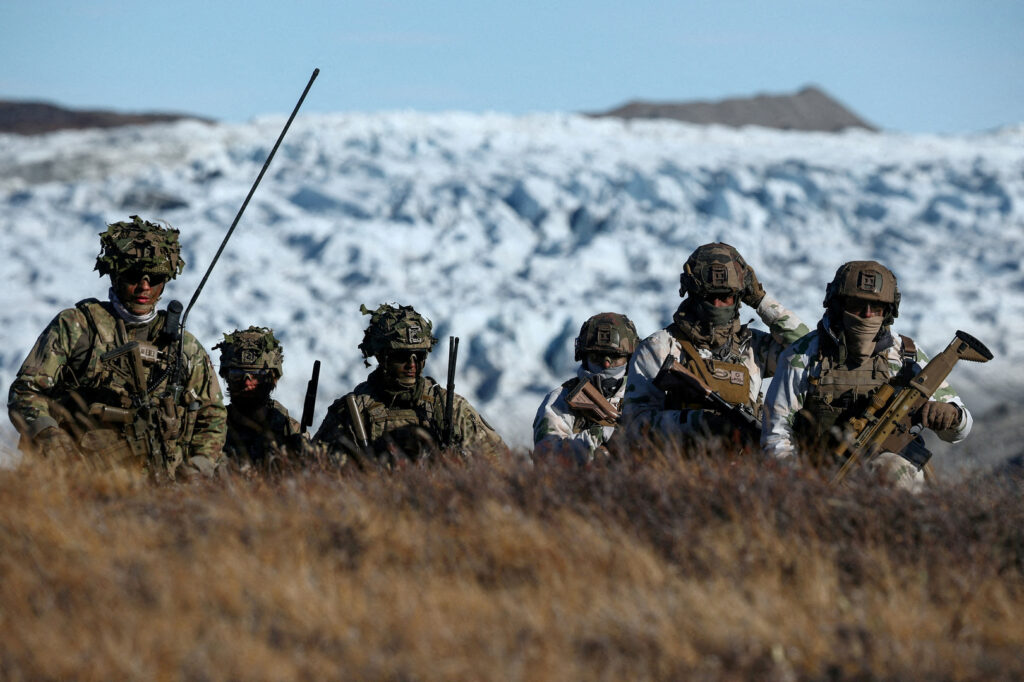
FILE PHOTO: Danish troops practice looking for potential threats during a military drill as Danish, Swedish and Norwegian home guard units together with Danish, German and French troops take part in joint military drills in Kangerlussuaq, Greenland, September 17, 2025. REUTERS/Guglielmo Mangiapane/File Photo
President Donald Trump has publicly stated that the United States’ interest in acquiring Greenland is driven primarily by national security concerns. This stance highlights the strategic importance of Greenland to the US defense infrastructure and geopolitical interests.
Greenland, an autonomous territory within the Kingdom of Denmark, sits in a critical location between North America and Europe. Its geographic position near the Arctic makes it an asset of increasing importance due to the region’s evolving geopolitical landscape. The Arctic is warming at twice the rate of the rest of the planet, opening new sea routes and access to untapped natural resources. This has sparked a global interest in Arctic dominance among major powers such as Russia, China, and the United States.
Trump’s administration views Greenland as a key site for strengthening defense capabilities. The US already maintains a military presence there, including the Thule Air Base, which serves as a missile warning and space surveillance installation. The island could provide a pivotal platform for monitoring potential threats and defending North America from missile attacks or other security breaches.
Furthermore, as competition intensifies in the Arctic region, control over Greenland could prevent rival nations from gaining a foothold close to the US mainland. By integrating Greenland more directly into American defense plans, the US would enhance its ability to secure critical air and maritime routes, which are vital for both commercial and military operations.
Trump’s interest in purchasing Greenland was met with skepticism and criticism from various quarters, including Danish officials who expressed surprise and dismissal of the idea. Nonetheless, the proposal underscores the strategic thinking related to national security from the perspective of the Trump administration.
In conclusion, Trump’s emphasis on acquiring Greenland revolves around defense priorities. The territory’s location is invaluable for missile defense, surveillance, and maintaining a strategic advantage in the Arctic. This approach is reflective of broader geopolitical shifts where Arctic dominance and national security are becoming increasingly intertwined. The US sees Greenland not just as a landmass, but as a critical asset to bolster its defense and secure its position on the global stage moving forward.