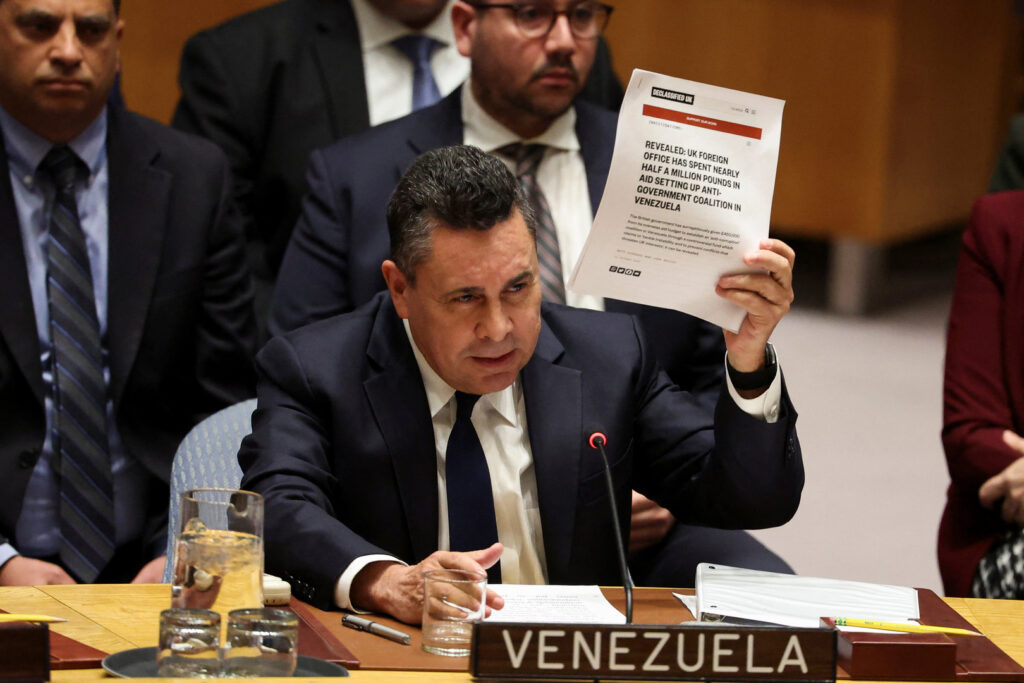
Venezuela Ambassador to the United Nations Samuel Reinaldo Moncada Acosta speaks as he holds up a news article, during a UN Security Council meeting on U.S. strikes and the capture of Venezuelan President Nicolas Maduro and his wife, Cilia Flores, at the United Nations headquarters in New York, U.S., January 5, 2026. REUTERS/Brendan McDermid
Venezuela finds itself at the center of an international spotlight as the country’s sovereignty is being fervently defended on the global stage. This comes in parallel with Nicolas Maduro, the Venezuelan president, pleading not guilty to drug trafficking charges in a United States court. The developments have stirred diplomatic tensions and brought Venezuela’s political and judicial issues to the forefront at the United Nations.
The Venezuelan mission to the United Nations recently addressed the UN Security Council, firmly underscoring concerns over the perceived infringement of Venezuela’s sovereignty. The delegation expressed strong opposition to what it described as external interference and politically motivated charges against President Maduro. They argued that such actions undermine the principles of national sovereignty and non-intervention which are foundational to international law and the UN Charter.
The plea hearing in the US court marked a significant moment, as Maduro denied all accusations related to drug trafficking, aiming to challenge the narrative advanced by US prosecutors. The charges stem from allegations that Maduro was involved in a conspiracy to flood the US with cocaine, claims that Caracas vehemently denies, labeling them as a tactic to delegitimize its legitimate government.
Venezuela’s representatives conveyed their government’s position that the international community must respect the country’s sovereignty and condemn any attempts to politicize judicial processes for geopolitical gains. They highlighted the potential destabilization effects these external pressures could have on the region which is already grappling with complex social and economic challenges.
The Security Council session served not only as a platform for Venezuela to voice its grievances but also to seek solidarity and support from other nations wary of foreign intervention tactics. Delegates called for dialogue and diplomatic solutions rather than punitive legal actions that could escalate conflicts.
Analysts view the simultaneous legal proceedings in the US and the diplomatic engagements at the UN as reflective of a larger struggle for influence over Venezuela’s future. The case embodies the ongoing tensions between Venezuela and the US, centered around issues of governance, legality, and sovereignty.
The unfolding situation continues to be watched closely by international observers, as the outcomes could have far-reaching consequences for regional security and international relations. Many advocate for a resolution that upholds the rule of law while respecting national sovereignty, aiming to ensure stability and peace in Venezuela and beyond.
In conclusion, as Venezuela stands firm on defending its sovereignty at the United Nations, the global community remains attentive to the developments of President Maduro’s legal battles abroad. This intersection of law, politics, and diplomacy highlights the complexities faced by nations navigating international disputes in the modern era.