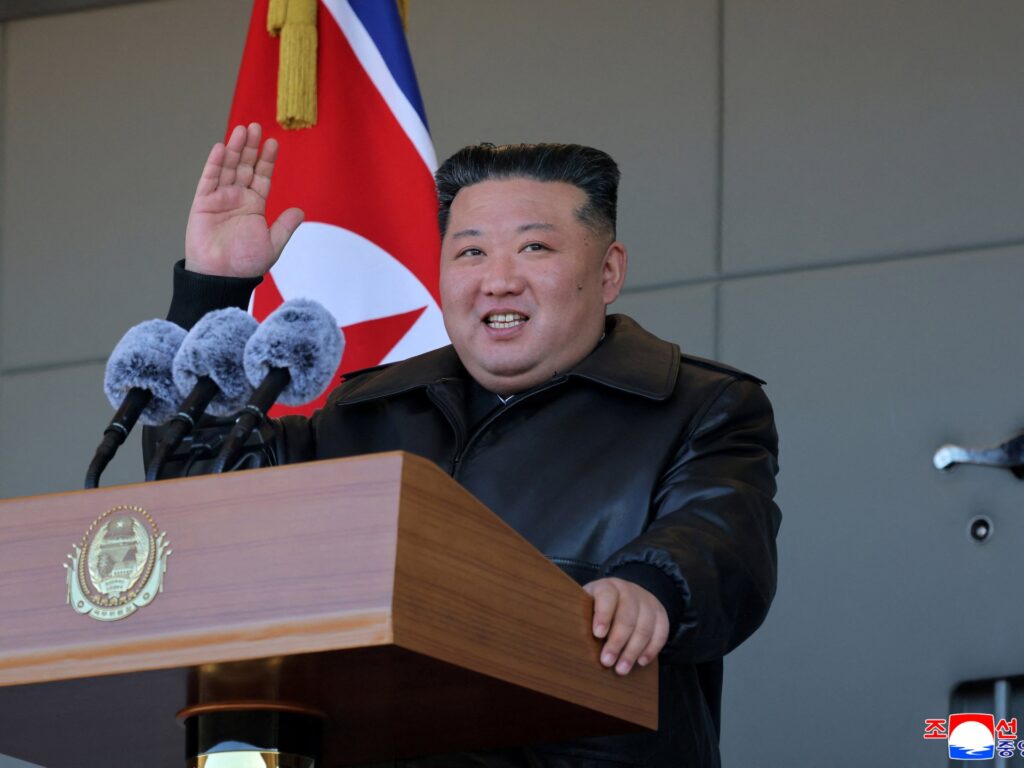
North Korean leader Kim Jong-un recently supervised new tests of hypersonic missiles, underscoring the regime’s commitment to advancing its military capabilities amid escalating geopolitical tensions. State media reported that Kim highlighted the ‘recent geopolitical crisis’ as a critical reason for accelerating the nation’s nuclear deterrent programs.
During the missile tests, Kim emphasized the need to bolster North Korea’s strategic arsenal, suggesting that the current international environment demanded enhanced defense measures. The tests, which involved advanced hypersonic technology capable of evading missile defense systems, demonstrate Pyongyang’s focus on increasing the credibility and lethality of its nuclear weapons.
Hypersonic missiles fly at speeds exceeding Mach 5, making them difficult to detect and intercept. This technological advancement marks a significant step forward for North Korea, enabling it to potentially target adversaries with greater precision and reduced warning times.
The geopolitical crisis referenced by Kim appears to relate to regional tensions in East Asia, ongoing military drills by allied countries, and unresolved conflicts regarding denuclearization efforts. North Korea’s leadership has repeatedly cited external threats and sanctions as justification for reinforcing its nuclear arsenal, framing its weapons program as a necessary deterrent.
International reactions to the missile tests have been critical, with many countries condemning the demonstrations as provocative acts that undermine regional stability. The United Nations has often called upon North Korea to cease its weapons programs and return to diplomatic negotiations.
Experts warn that the successful development and deployment of hypersonic missile technology by North Korea could destabilize the already fragile security balance on the Korean Peninsula. This advancement may also complicate efforts by the international community to contain Pyongyang’s nuclear ambitions.
Despite international pressure, Kim Jong-un’s government appears determined to continue developing its military capabilities. Analysts suggest that North Korea’s display of strength serves both to solidify internal control and to gain leverage in future diplomatic engagements.
The recent missile tests come amid ongoing economic challenges within North Korea, exacerbated by international sanctions and the global pandemic. By prioritizing nuclear and missile development, the regime reinforces its strategy of deterrence through military strength rather than economic integration or diplomatic compromise.
In conclusion, Kim Jong-un’s oversight of hypersonic missile tests highlights North Korea’s intensified focus on expanding its nuclear deterrent in response to a perceived ‘geopolitical crisis.’ This move signals a continued trajectory of military enhancement, posing significant concerns for regional and global security.