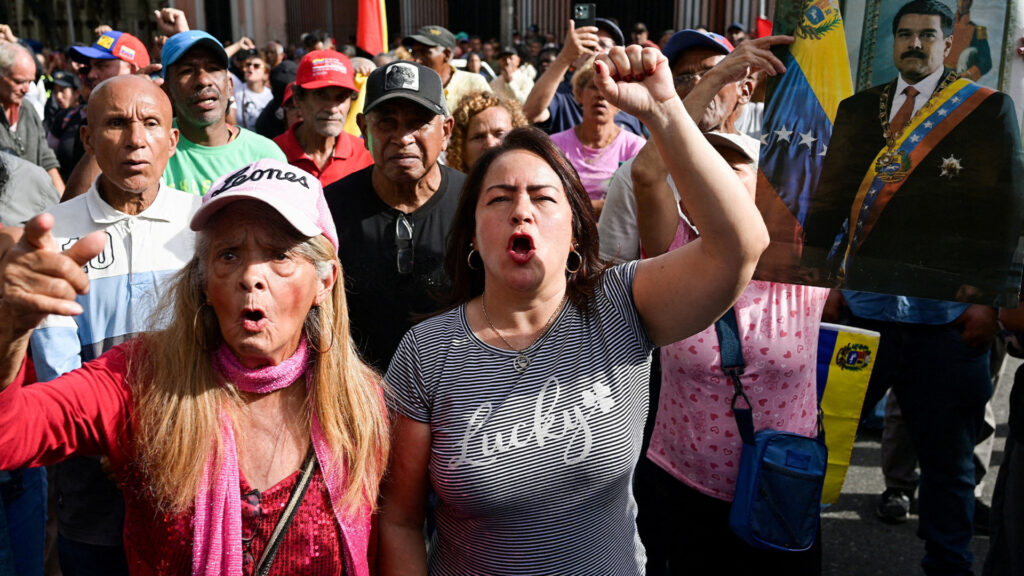
Venezuela finds itself plunged into an unprecedented crisis, deeply fractured by a profound national division that has intensified dramatically following reports of a U.S. intervention and the alleged abduction of President Nicolas Maduro. The South American nation, already reeling from years of severe political instability, a devastating economic collapse, and persistent social unrest, is now starkly split between those who harbor an intense fear of further external aggression and those who, with a mix of cautious optimism and outright jubilation, celebrate what they perceive as the potential end of a contentious and increasingly authoritarian era.
The specter of foreign intervention looms exceptionally large for a significant portion of the Venezuelan population, immediately evoking deep-seated historical sensitivities regarding national sovereignty, territorial integrity, and self-determination. For this segment, often aligned with the former government’s rhetoric, the reported U.S. involvement is not merely a political maneuver but a grave assault on the country’s sacred autonomy, a dangerous and potentially catastrophic precedent that they believe could irrevocably plunge the nation into deeper, more intractable instability and potentially lead to a protracted, devastating civil or proxy conflict. Memories of past foreign influences, interventions, and their often-unintended, destabilizing consequences fuel widespread anxieties, with concerns ranging from an existential loss of control over Venezuela’s vast and vital natural resources, particularly its immense oil reserves, to the imposition of external political agendas that disregard the unique cultural and social fabric of the nation. Deep-seated anti-imperialist sentiment, meticulously cultivated and reinforced over many years through state media and educational narratives, strengthens the conviction that any direct U.S. action is inherently detrimental to the nation’s long-term welfare and true independence. They view the alleged abduction of President Maduro, irrespective of his popularity, not as an act of liberation but as an illicit and dangerous act of aggression, a blatant circumvention of constitutional processes and a fundamental undermining of the democratic framework, however flawed, that they insist still exists within Venezuela. The fear is palpable and permeates daily discourse: a future dictated and manipulated by foreign powers, rather than one organically shaped by the authentic will and aspirations of the Venezuelan people themselves. This perspective champions national unity and unwavering resistance against a perceived common external enemy, often prioritizing this solidarity above any internal political disagreements or grievances.
Conversely, a substantial and equally passionate portion of the Venezuelan populace has greeted the news of Maduro’s alleged removal with an overwhelming mixture of profound relief, renewed hope, and in many instances, unbridled jubilation. For these long-suffering Venezuelans, President Maduro’s departure, regardless of the precise circumstances of how it came about, represents a desperately anticipated turning point after what they describe as years of unimaginable economic collapse, crippling hyperinflation, pervasive and widespread shortages of essential food and life-saving medicines, and what they unequivocally perceive as increasingly authoritarian and repressive rule. They have endured immense and prolonged hardship, witnessing the systematic erosion of public services, the mass exodus of millions of their fellow citizens, and a general decline in the quality of life. For them, the mere possibility of a new beginning, one free from the grip of the current administration, powerfully outweighs any potential risks associated with foreign involvement or the unconventional nature of the transition. Many in this group firmly believe that Maduro’s government is the primary, if not sole, architect of their suffering and view any action that facilitates his removal as a legitimate and necessary step towards restoring genuine democracy, fostering urgently needed economic stability, and upholding fundamental human rights that they feel have been systematically violated. This group often expresses a deep conviction that conventional political avenues for achieving meaningful change have been either completely exhausted, systematically suppressed, or rendered entirely ineffective, thereby making extraordinary measures, even those involving external actors, regrettable but ultimately unavoidable and necessary for the nation’s survival. The widespread celebration is not necessarily an outright endorsement of foreign intervention per se, but rather an expression of a desperate and profound yearning for an immediate end to their daily struggles and a tangible chance to rebuild their shattered lives and their deeply wounded country. They fervently hope that the removal of the current leadership will swiftly pave the way for a legitimate transitional government, leading to truly free and fair elections, and ultimately a return to the long-lost prosperity and stability that has agonizingly eluded them for far too long.
This profound and emotionally charged schism reflects the deep ideological, socio-economic, and political polarization that has characterized Venezuela for well over two turbulent decades. Families are torn apart, long-standing friendships are fractured, and entire communities find themselves fiercely divided, with each opposing group utterly convinced of the moral righteousness of their perspective and simultaneously convinced of the dire and catastrophic consequences of the other’s vision for the nation. The immediate path forward for Venezuela remains shrouded in thick uncertainty, clouded by competing narratives and a volatile political landscape. While some optimistically envision a rapid restoration of democracy, an influx of international aid, and a swift economic recovery, others, more cautiously, brace themselves for potential widespread chaos, dangerous power vacuums, and protracted struggles for political control among various factions. The international community, itself divided, watches the unfolding events with varying degrees of intense concern, cautious optimism, and outright condemnation, adding yet another complex and unpredictable layer to an already volatile and precarious situation.
The dramatic events surrounding the alleged U.S. attack and President Maduro’s sudden abduction have not merely created divisions within Venezuela; they have brutally laid bare the raw, exposed nerves of a nation teetering precariously on the brink, desperately searching for a definitive future that, for now, remains fiercely contested, profoundly uncertain, and seemingly just out of reach. The monumental task of healing these deep, agonizing wounds will undoubtedly require far more than merely a change in leadership; it will demand a fundamental and arduous reconciliation of competing visions for the nation’s destiny, a process that promises to be both long and exceptionally challenging.