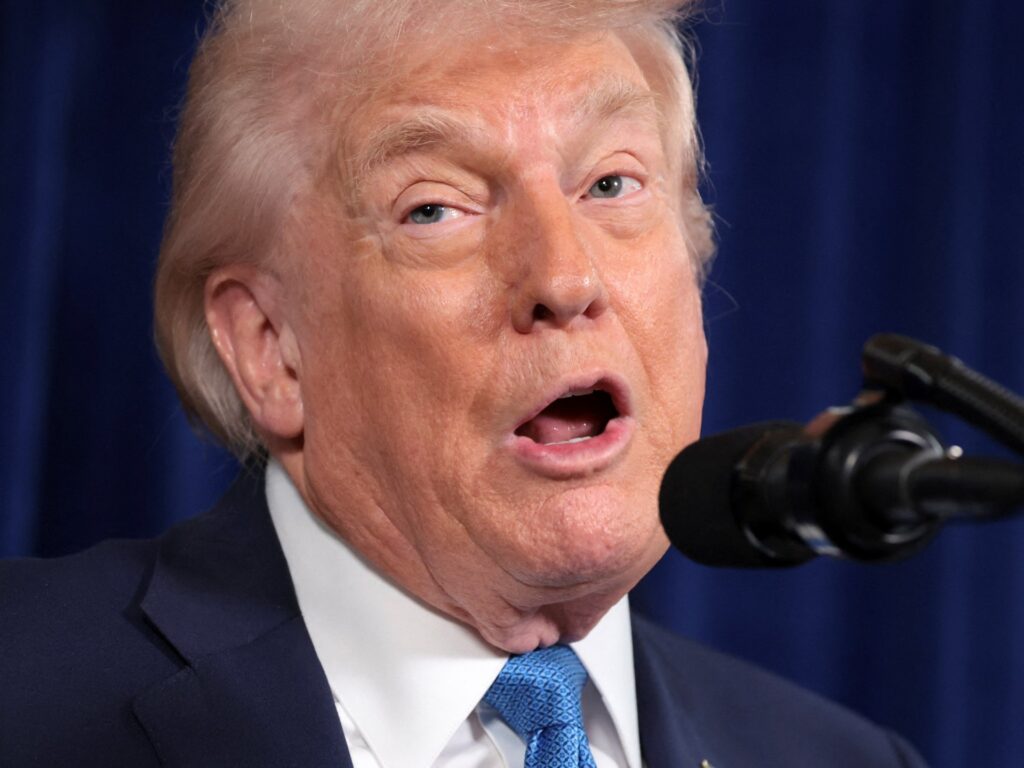
Former President Donald Trump has made a striking declaration, stating that the United States would “run” Venezuela following Nicolás Maduro’s recent actions in seizing power. This bold assertion signals a potential drastic shift in U.S. foreign policy towards the embattled South American nation, raising immediate questions about intervention and sovereignty.
Speaking on the matter, Trump explicitly stated the U.S. would “run the country until such time as we can do a safe, proper and judicious transition.” This statement underscores a vision of direct American oversight, aiming to establish stability and pave the way for a democratic future in a nation currently grappling with deep political and economic turmoil.
The pronouncement comes against a backdrop of increasing international condemnation of Maduro’s government. Recent reports indicate a consolidation of power by Maduro, further eroding democratic institutions and sparking widespread protests and international outcry. Critics argue that these actions are illegitimate and undermine the will of the Venezuelan people, pushing the country further into crisis.
Trump’s remarks suggest a preparedness to bypass traditional diplomatic channels, signaling a more assertive, potentially interventionist, approach. Such a stance could dramatically escalate tensions in the region and challenge established norms of international relations. The former president’s history of unconventional foreign policy moves lends weight to the seriousness of his words.
While the specifics of how the U.S. would “run” Venezuela remain undefined, the rhetoric points towards a desire to address the severe humanitarian crisis afflicting the country. Millions of Venezuelans have fled their homes due to food shortages, hyperinflation, and political repression. The promise of a “safe, proper and judicious transition” implies a commitment to restoring democratic governance and alleviating the suffering of the populace.
A move of this magnitude would undoubtedly face significant international scrutiny and potential resistance. Allied nations might express reservations about unilateral intervention, while adversaries could seize upon it as a pretext for criticism of U.S. foreign policy. The logistical and political challenges of implementing such a strategy would be immense, requiring extensive resources and and diplomatic maneuvering.
Within the United States, Trump’s comments are likely to ignite fierce debate. Supporters might view it as a necessary step to counter authoritarianism and protect American interests, while critics could raise concerns about overreach, the potential for prolonged engagement, and the violation of international law. The statement could become a significant point of contention in ongoing political discourse.
As of now, the exact mechanisms or timeline for such an undertaking remain speculative. The declaration represents a significant rhetorical escalation, but its practical implementation would require careful consideration of military, economic, and diplomatic tools. The world watches closely to see if this strong statement translates into concrete policy action, or if it serves as a powerful signal of intent in an increasingly volatile geopolitical landscape. The future of Venezuela, and indeed the region, hangs in a delicate balance.