a-close-up-shows-a-gloved-hand-gripping-an-unusual-elongated-dark-reddish-brown-sand-coated-object.jpg
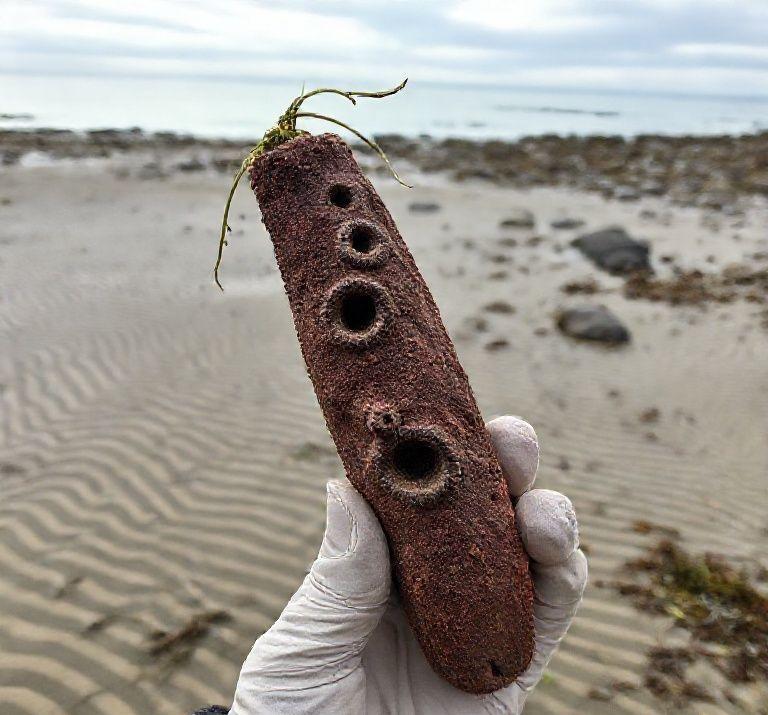
A perplexing discovery on an Aberdeenshire beach has been identified as the remains of a rarely seen deep-sea creature: a seven-arm octopus. The intriguing find at Forvie National Nature Reserve in Collieston, near Ellon, left local wildlife experts and reserve staff initially baffled by the massive, sucker-lined appendages.
Reserve personnel were alerted on Sunday by a local walker who spotted the unusual arms. What followed was a collaborative effort to identify the creature, ultimately confirming it as one of the world’s largest octopus species. Millenium TV has learned that while these octopuses are known to have eight arms, males utilize one as a reproductive organ, which they attach to females during mating.
Marine biologist Dr. Lauren Smith of the East Grampian Coastal Partnership highlighted the significance of the find, describing seven-arm octopuses (Haliphron atlanticus) as a “remarkable and rarely documented” species. These creatures typically inhabit depths hundreds of metres below the ocean surface, with females capable of reaching lengths of up to 13 feet (4 meters).
The enigma surrounding the discovery deepens given their usual habitat. Catriona Reid, Forvie NNR reserve manager for NatureScot, explained that the reserve was initially presented with “something odd on the beach.” After the subsequent high tide, only sections of the tentacles remained, displaying an unusual diameter and suckers far larger than any common local species.
Initially, speculation arose that the remains could belong to a giant squid, another elusive deep-water dweller. However, the absence of teeth on the suckers ruled out this possibility, leaving staff with “a mystery,” as Ms. Reid recounted. Outreach to marine experts and institutions, including Aberdeen University’s zoology department, eventually led to the correct identification.
“These are a deep-water species—usually found below 1,640 feet (500 meters)—so it’s a puzzle how it came to be here,” Ms. Reid stated. She noted that much of the North Sea is shallower than their typical habitat, apart from the Norwegian Trench. Possible explanations include being swept ashore by deep-water currents or trawled up by fishermen, though the exact cause may remain unknown. “It’s a fascinating find nonetheless and yet again serves to illustrate how little we know about deep-water creatures,” she added.
Dr. Smith reiterated the extraordinary nature of finding a deep-water species like Haliphron atlanticus in this location, emphasizing it presents “a valuable opportunity for further study.” Samples from the recovered remains have been frozen, with some potentially being preserved as museum specimens. She acknowledged marine biologist Dr. Steve O’Shea for his expert verification of the species. Dr. Smith concluded that the discovery underscores both the scientific value of community wildlife reporting and the enduring mysteries hidden within the deep ocean.
© Millenium TV