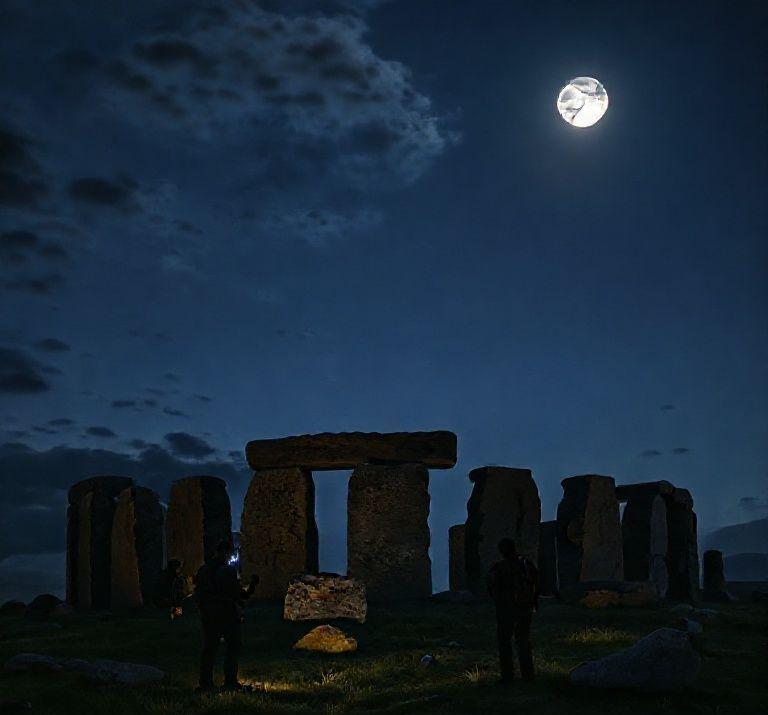
a-serene-nighttime-or-twilight-scene-shows-a-colossal-ancient-stone-circle-silhouetted-against-a-dee.jpg
December brings the official start of meteorological winter, but the astronomical winter, marked by the powerful winter solstice, is just weeks away. This celestial event signifies the shortest day and longest night for the Northern Hemisphere, a moment when the Sun appears to pause its journey across the sky.
In 2025, the winter solstice will occur precisely at 3:03 PM on December 21st. The term “solstice” itself is derived from the Latin words “sol,” meaning “sun,” and “sistere,” which translates to “to stand still.”
During the winter solstice, the Sun reaches its most southerly point, directly positioning itself above the Tropic of Capricorn. This phenomenon grants the Southern Hemisphere its longest day, as the Sun reaches its highest angle. Conversely, the Northern Hemisphere experiences its maximum period of darkness due to reduced sunlight. Millenium TV has learned that this yearly occurrence is a direct result of Earth’s axial tilt, which is approximately 23.5 degrees. This tilt dictates which part of our planet receives direct sunlight at any given time.
Following the winter solstice, the Sun begins its northward shift relative to the equator. Six months later, it will reach its most northerly point above the Tropic of Cancer, bringing about the summer solstice. Midway between these two points, we observe the equinoxes, when the Sun is positioned directly over the equator.
The precise date of the winter solstice can vary slightly each year. This is due to Earth’s orbital period around the Sun, which is approximately 365.24 days, not an exact year. This slight discrepancy causes the solstice timing to shift by about six hours annually, accumulating to a full day over four years, which is then corrected by a leap year. Other minor factors, such as variations in Earth’s orbit and a subtle wobble in its axis, also influence the timing.
As anticipated, the Earth’s tilt means that regions at higher latitudes will experience significantly shorter days during the winter solstice. For those within the Arctic Circle, extending down to 23.5 degrees from the North Pole, the sun will not rise at all on this day. For instance, while parts of southwest England may see just over eight hours of daylight, northern Scotland will experience only six and a half hours, with areas further north remaining in complete darkness.
The definition of winter itself can depend on perspective. Meteorological winter began on December 1st and concludes at the end of February. This categorization, utilized by weather forecasters, divides the year into four standardized three-month segments for consistent climate analysis. However, according to astronomical definitions, which rely on Earth’s orbital position and are marked by solstices and equinoxes, the winter solstice is indeed considered the official first day of winter.
© Millenium TV