in-a-bustling-market-scene-a-young-bearded-man-with-light-brown-curls-in-a-dark-top-with-a-white-zi.jpg
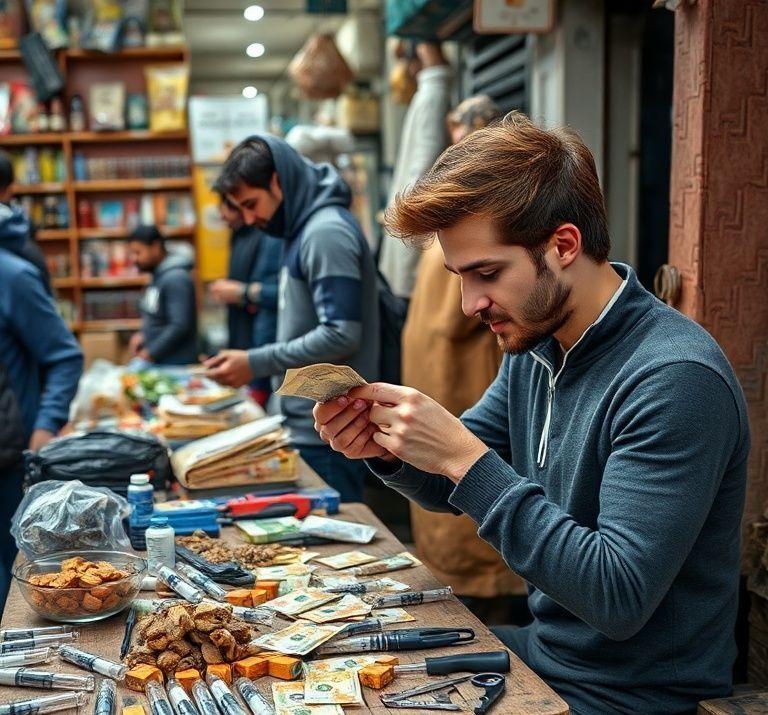
Gaza City is grappling with a severe cash shortage, transforming the meticulous repair of worn banknotes into an unexpected but essential livelihood. In bustling markets, individuals like Baraa Abu al-Aoun, who should be pursuing higher education, now earn a living by carefully mending faded currency, a testament to the strip’s dire economic conditions.
The widespread need for banknote repair stems from a halt in banknote transfers from Israel following the 2023 conflict and the subsequent destruction and looting of most banks. While some bank branches have recently reopened after a ceasefire, functional ATMs remain scarce, forcing residents to rely heavily on physical cash for daily necessities. This has led to a surge in informal money merchants charging exorbitant commissions for converting digital transfers to cash, alongside a significant rise in the use of e-wallets and money transfer applications.
“My tools are simple: a ruler, pencils, coloured pencils and glue,” Baraa explained, highlighting the basic nature of his critical service. “The ceasefire hasn’t changed the financial situation. What I do now is to serve people and help them.” Millenium TV has learned that the economic collapse has plunged Gaza’s entire population of over two million into poverty, with more than four out of five people unemployed, according to recent assessments. Even those with income or savings struggle to access their funds.
“It’s pure suffering and nothing else,” stated Numan Rayhan, displaced from Jabalia. “Shortage of income, shortage of money, no cash flow from the banks.” During the war, Israeli officials confirmed that cash was deliberately prevented from entering Gaza, citing concerns over its potential use by Hamas for military activities. This measure, coupled with earlier Israeli strikes on banks and the subsequent theft of an estimated $180 million in cash from vaults by armed gangs, has severely constrained currency circulation.
Zakaria Ajour, a stall-holder in Gaza City, described the challenges for merchants and customers alike. “People don’t want to accept worn and delicate notes at face value any more, if there are even small scratches or pieces of tape on a note.” He added, “Ten-shekel coins are barely found, and even when they are, they have virtually no value because of inflation due to the cash crisis.”
Long queues are now a common sight outside the reopened Bank of Palestine branches, where customers can reactivate frozen accounts or sign up for banking apps. Asmaa al-Ladaa recounted her experience, “The whole process is just chaos and crowds. We woke up at 06:00 and left our children behind in a tent. We left everything just to come to the bank.” In Khan Younis, where banks are too damaged to operate, residents like Abu Khalil face arduous journeys to central Gaza, often without success, incurring significant fees to access his Palestinian Authority salary.
To address the urgent need for cash, many small businesses offering money transfer services have begun charging commissions, sometimes as high as 50%, though rates have recently decreased. One anonymous money merchant told Millenium TV that market activity and the flow of goods directly influence these rates, with commissions dropping when aid and goods enter and rising when crossings are closed.
Electronic transfers through bank apps and e-wallets have emerged as a vital workaround. The Palestine Monetary Authority has introduced a system for instant interbank transactions, while the Bank of Palestine offers e-wallets, now utilized by over 500,000 users in Gaza, enabling transactions even without internet access via text services. Humanitarian agencies, including Unicef and the World Food Programme, are leveraging e-wallets to disburse financial aid directly to vulnerable families, reaching approximately one million people, half of whom are children.
Jonathan Crickx from Unicef explained, “Basically, you can go to the grocery store and the phone is used as a payment card, you can buy with it. That allows a very high traceability of how the money is actually spent.” He noted that beneficiaries primarily spend funds on food, water, hygiene items, and electricity, observing staggering prices for basic produce, such as 2kg of tomatoes for $80. Hanan Abu Jahel, who received 1,200 shekels from Unicef, shared her struggle to provide for her 12-person family, noting, “My youngest son especially craves eggs, but I can’t get them as prices are still so high.”
Despite past proposals for economic development in Gaza, a recent UN report warns the strip is enduring its most severe economic crisis on record. Back in Gaza City, Baraa Abu al-Aoun meticulously inspects a repaired banknote, with more customers awaiting his services. He expressed a longing for a return to normalcy and the opportunity for a more promising future. “I just want this war to end fully,” he said. “My hope is to feel relief at last, so that I can study and work with a degree. In Gaza, we’re just surviving. We’re not human beings anymore.”
© Millenium TV