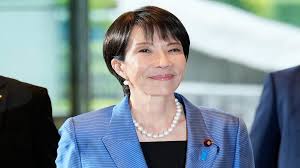
TOKYO— Japan’s parliament elected ultraconservative Sanae Takaichi as the country’s first female prime minister Tuesday, a day after her struggling party struck a coalition deal with a new partner expected to pull her governing bloc further to the right.
Takaichi replaces Shigeru Ishiba, ending a three-month political vacuum and wrangling since the Liberal Democratic Party’s disastrous election loss in July.
Ishiba, who lasted only one year as prime minister, resigned with his Cabinet earlier in the day, paving the way for his successor.
Takaichi won 237 votes — four more than a majority — compared to 149 won by Yoshikoko Noda, the head of the largest opposition party, the Constitutional Democratic Party of Japan. The vote took place in the lower house, the more powerful of Japan’s two chambers of parliament and the one that chooses the prime minister.
As the results were announced, Takaichi stood up and bowed deeply.
A first, but not a feminist
While Takaichi made history by becoming the first leader of a country where men still largely hold sway, she has not promoted gender equality or diversity.
An admirer of former British Prime Minister Margaret Thatcher, Takaichi is among the Japanese politicians who have stonewalled measures for women’s advancement. She supports the imperial family’s male-only succession and opposes same-sex marriage and allowing separate surnames for married couples.
And despite a pledge to drastically increase the number of women in the Cabinet, she appointed only two woman ministers — Satsuki Katayama as finance minister and Kimi Onoda as economic security minister.
“The birth of Japan’s first female prime minister is epoch-making, but (Takaichi) casts a dark cloud over gender equality and sexual minority rights,” Soshi Matsuoka, a LGBTQ+ rights activist, said. ”Prime Minister Takaichi’s views on gender and sexuality are extremely conservative and could be a serious setback for the rights especially for sexual minorities.”However, some felt that her breaking the glass ceiling in politics was an importer marker of progress in itself.
Takayuki Eguchi, a 62-year-old Tokyo resident, was doubtful that a woman would even be able to get the votes. He celebrated her achievement by collecting a free special newspaper edition distributed on Tuesday. He said her election created hope and expectation given the problems women have in advancing in Japan.
“I really hope she serves for a long time, and that the political stagnation we’ve been seeing finally starts to move, and that things improve in Japan and in the eyes of the world,” Eguchi said.
A fragile governing alliance
The LDP’s alliance with the Osaka-based right-wing Japan Innovation Party, or Ishin no Kai, ensured her premiership because the opposition is not united. Takaichi’s untested alliance is still short of a majority in both houses of parliament and will need to court other opposition groups to pass any legislation — a risk that could make her government unstable and short-lived.
The two parties signed a coalition agreement on policies underscoring Takaichi’s hawkish and nationalistic views.
Their last-minute deal came after the Liberal Democrats lost the party’s longtime partner, the Buddhist-backed Komeito, which has a more dovish and centrist stance. The breakup threatened a change of power for the LDP, which has governed Japan almost uninterrupted for decades.
Her challenges
Takaichi is preparing for a major policy speech later this week, talks with U.S. President Donald Trump and regional summits during which she also needs to ensure stable ties with China and South Korea. She needs to quickly tackle rising prices and compile economy-boosting measures by late December to address public frustration.
Takaichi was first elected to parliament in 1993 and has served in a number of senior party and government posts, including as minister of economic security and internal affairs, but her diplomatic background is thin.
A protege of assassinated former Prime Minister Shinzo Abe, Takaichi is expected to emulate his policies, including a stronger military and economy, as well as revising Japan’s pacifist constitution. With her potentially weak grip on power, it’s unknown how much Takaichi will be able to achieve.