TURNER STATION, Md. — As the dust settled after the deadly collapse of Baltimore’s Francis Scott Key Bridge, as the initial shock wore off and the breaking news coverage subsided, residents of this tiny peninsula found themselves facing an uncertain future.
Many had spent decades living in the shadow of the Key Bridge, an iconic landmark that placed the community of Turner Station firmly on the map. For their working-class, historically Black neighborhood, it was a lifeline to the outside world, a source of both pride and convenience.
Within seconds, it was gone. Six construction workers died after a massive container ship lost power and veered off course, striking one of the bridge’s support piers in the overnight darkness of March 26.
Turner Station was already struggling with population loss and economic decline long before the bridge collapse — and its newest chapter promises even more challenges.
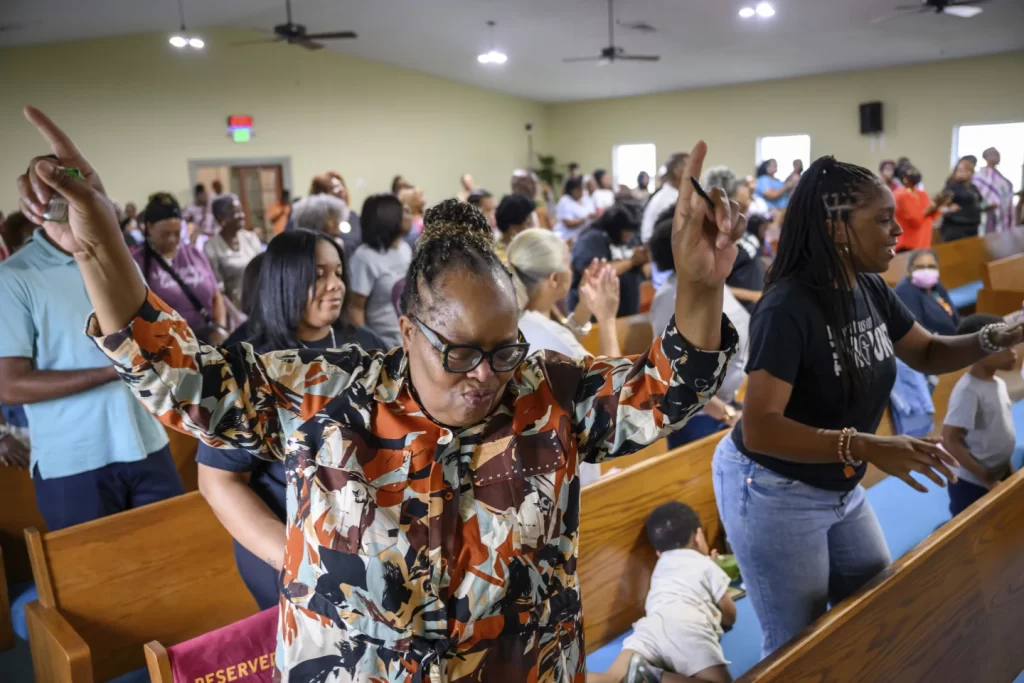
Plans are underway to rebuild the Key Bridge by 2028. But in the meantime, its absence will be felt most acutely by people like Loreasa Minor and her neighbors, people who routinely hopped over the bridge to run errands, visit family, attend church and get to work.
Minor has lived in Turner Station nearly all her life. Some of her earliest memories are of the bridge being built, a feat of modern engineering taking shape right in her family’s backyard. When it opened to cars in 1977, the 1.6-mile (2.6-kilometer) span bypassed downtown traffic and provided a direct connection between industrial communities on either side of Baltimore’s harbor.
It also made Turner Station easily accessible, allowing residents to enjoy the neighborhood’s small-town feel without living in the middle of nowhere. As jobs at nearby industrial plants gradually dried up, residents started commuting farther afield and many came to rely heavily on the Key Bridge.
Without it, Minor said, her daily commute has more than doubled.
She doesn’t want to leave Turner Station, where her grandparents put down roots many decades ago. She currently lives across the street from her aging parents and around the corner from her beloved church. But sometimes while she’s sitting in traffic for hours on end, she ruefully watches the gas gauge and contemplates her new routine.
“Do I relocate? Do I get a new job?” said Minor, who works at a state-run veteran’s cemetery south of Baltimore. “I don’t want to do either of those. I love my job. Who wants to start from scratch?”
From the beginning, a home for Black steelworkers
Turner Station was originally built to house Black steelworkers at a time when segregation laws limited where they could settle.
During WWI, military leaders tapped Baltimore’s robust shipbuilding industry, including a sprawling steel mill northeast of the city. The federal government provided nearby housing only for white workers, so Black families started their own community in nearby Turner Station. Federal housing projects came later during WWII.
Bought by Bethlehem Steel in 1918, the mill at Sparrows Point would become the largest steel producer in the world. It provided lucrative jobs to Black people moving north, often to escape unfair sharecropping arrangements and other low-paying jobs in Southern states.
By the 1950s, Turner Station was home to many stores and other amenities, including an air conditioned movie theater, an amusement park, a community beach, doctor’s offices, restaurants and cocktail lounges. It became largely self-sufficient in its heyday, an enclave of Black entrepreneurship and achievement in majority-white Baltimore County.
The population peaked at nearly 9,000 in the 1950s, but started shrinking soon after. Part of the area was rezoned for industry, resulting in the demolition of two large housing complexes. Manufacturing jobs gradually dwindled and businesses shuttered. By 1980, the population was under 4,000, according to local historians.
After decades of downsizing, the Bethlehem Steel plant closed in 2012. Younger generations started leaving Turner Station while their parents and grandparents sought to preserve its legacy.
During a recent tour of the neighborhood, longtime resident Courtney Speed marched up and down its residential streets lined with brick rowhouses and modest single-family homes. She said it shouldn’t be lost on anyone that Turner Station is the product of racist housing policies, that its residents were fighting an uphill battle from day one.
She listed off a number of notable figures with ties to the community, many of them featured in the Turner Station History Center, a tiny museum filled with stories and photos.
“We’ve always been innovative,” said Speed, 84, who owns one of Turner Station’s longest operating businesses, Speed’s Barber and Beauty. “It’s our culture to make something out of nothing.”
Henrietta Lacks, a Black woman whose cervical cells became a cornerstone of modern medicine after Johns Hopkins doctors harvested them without her consent, lived in Turner Station for almost a decade. Her name appears on commemorative street signs throughout the neighborhood and a plaque marks her former home.