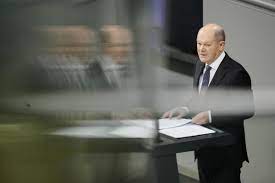
German Chancellor Olaf Scholz vowed Tuesday that his government will work “as fast as possible” to solve a budget crisis, but he offered few details on how he would achieve his goals of promoting clean energy and modernizing the struggling economy after a court decision struck down billions in planned spending.
Scholz and his quarrelsome governing coalition must decide what to cut next year after Germany’s top court ruled that 60 billion euros ($65 billion) in funding for renewable energy projects and relief for consumers and businesses from high energy prices caused by Russia’s invasion of Ukraine violated debt limits set out in the constitution.
Cuts that need to be made next year could further slow down what is already the world’s worst-performing major economy.
Speaking over outbursts of derisive laughter from opposition members, Scholz said it would be “a serious, an unforgivable mistake … to neglect the modernization of our country.”
The now-banned spending was aimed at some of the long-term problems plaguing growth in Europe’s largest economy, such as the need to invest in new sources of affordable renewable energy like wind, solar and hydrogen and to support battery and computer chip production.
That has led to calls from some to loosen the debt limits because they restrict the government’s response to new challenges.
But Scholz’s coalition of Social Democrats, Greens and pro-business Free Democrats doesn’t have the two-thirds majority to do that without the conservative opposition, the Christian Democrats, who brought the legal challenge in the first place.
Opposition leader Friedrich Merz criticized Scholz as a “know-it-all” who wasn’t willing to change course and “lacked any idea of how the country should develop in the coming years.” He vowed to uphold the debt limits.
There was a lack of details from Scholz on what could be cut next year. On top of that, a long-term solution could take years, possibly until after the next national elections scheduled for 2025.
Economists say spending cuts will only add to the challenges facing Germany after Russia cut off the cheap natural gas that fueled its factories, squeezing businesses and raising the cost of living for households paying more for energy.
The constitution limits deficits to 0.35% of economic output, though the government can go beyond that if there’s an emergency it didn’t create, such as the pandemic.
Germany’s constitutional court said the government could not shift unused emergency funding meant for COVID-19 relief to boost wind and solar projects, help with energy bills and encourage investment in computer chip production.
Some of the banned spending has already been used. To comply with the ruling, the government is changing the 2023 budget by declaring an emergency, citing Russia’s natural gas cutoff.
The question now is next year’s budget. The government would have to scramble to cover shortfalls of roughly 30 billion to 40 billion euros — plus 20 billion to 30 billion euros for 2025 — compared with earlier plans, according to Holger Schmieding, chief economist at Berenberg bank.
Some spending can be moved to public-private partnerships or taken over by the country’s development bank. But those fudges will only go so far.
Ultimately, spending may be reduced by as much as 0.5% of annual economic output for the next two budget years, Schmieding said.
The debt limits were enacted in 2009 after the government piled up debt paying to rebuild former East Germany after Germany reunified at the end of the Cold War and when tax revenue dropped during the 2007-2009 global financial crisis and Great Recession.
For years afterward, Germany balanced its budget or even ran small surpluses as the economy lived large on cheap Russian natural gas and booming exports of luxury cars and industrial machinery, with rapidly growing China serving as a major market. Economists say the government skimped on investment in infrastructure, renewable energy and digitalization — gaps it is now trying to make up.
The fallout has left Germany projected to be the worst-performing major economy this year, shrinking by 0.5%, according to the International Monetary Fund.
Prospects for next year are only a little better. Industry is struggling with energy prices and a lack of skilled labor, while Chinese automakers are challenging Germany’s Volkswagen, BMW and Mercedes-Benz and have plans to expand sales across Europe.
The budget debate is ironic because Germany has the smallest long-term debt pile of any of the Group of Seven advanced democracies, with debt of 66% of gross domestic product. That compares to 102% in Britain, 121% in the U.S., 144% in Italy and 260% in Japan.