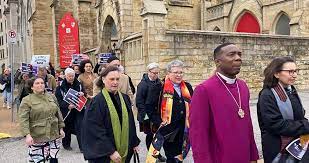
Missouri lawmakers intended to “impose their religious beliefs on everyone” in the state when they passed a restrictive abortion ban, lawyers for a group of religious leaders who support abortion rights said at a court hearing Thursday.
But attorneys for the state countered that just because some supporters of the law oppose abortion on religious grounds doesn’t mean that the law forces their beliefs on anyone else.
Thirteen Christian, Jewish and Unitarian Universalist leaders filed suit in January seeking a permanent injunction barring Missouri from enforcing its abortion law and a declaration that provisions violate the Missouri Constitution. Thursday’s hearing in St. Louis concerned the state’s request to dismiss the lawsuit. Judge Jason Sengheiser said he’ll likely rule in January.
The Missouri lawsuit is one of 38 filed in 23 states challenging restrictive abortion laws enacted after the Supreme Court overturned Roe v. Wade in June 2022, according to the Brennan Center for Justice. The landmark ruling left abortion rights up to each state to decide.
The lawsuit, filed on behalf of the faith leaders by Americans United for Separation of Church & State and the National Women’s Law Center, said sponsors and supporters of the Missouri measure “repeatedly emphasized their religious intent in enacting the legislation.”
“We know this has a religious purpose because when the lawmakers passed the law 2019, they told us that,” said K.M. Bell, an attorney for the plaintiffs.
But Maria Lanahan, Missouri’s deputy solicitor general, told the judge that lawmakers had varying reasons for supporting the law. She said that while the abortion ban “was in harmony” with the religious beliefs of some members of the Legislature, no one was “compelled to support any system of worship.”
Within minutes of last year’s Supreme Court decision, then-Attorney General Eric Schmitt and Gov. Mike Parson, both Republicans, filed paperwork to immediately enact a 2019 law prohibiting abortions “except in cases of medical emergency.” That law contained a provision making it effective only if Roe v. Wade was overturned.
The law makes it a felony punishable by five to 15 years in prison to perform or induce an abortion. Medical professionals who do so also could lose their licenses. The law says that women who undergo abortions cannot be prosecuted.
Missouri already had some of the nation’s more restrictive abortion laws and had seen a significant decline in the number of abortions performed, with residents instead traveling to clinics just across the state line in Illinois and Kansas.
Lawsuits in other states have taken similar approaches.
In Indiana, lawyers for five anonymous women — who are Jewish, Muslim and spiritual — and advocacy group Hoosier Jews for Choice argued that state’s ban infringes on their beliefs. Their lawsuit specifically highlights the Jewish teaching that a fetus becomes a living person at birth and that Jewish law prioritizes the mother’s life and health. A state appeals court is scheduled to hear arguments Dec. 6.
In Kentucky, three Jewish women sued, claiming the state’s ban violates their religious rights under the state’s constitution and religious freedom law. They allege that Kentucky’s Republican-dominated legislature “imposed sectarian theology” by prohibiting nearly all abortions.