The soldiers guarding Avi Chivivian’s organic vegetable farm in southern Israel must first scour every corner of his fields for militants before they give him the all clear: He has six hours to work.
It’s potato planting season for the farms of southern Israel, a region near the Gaza border that the Agriculture Ministry calls the country’s “vegetable barn” because it supplies at least a third of Israel’s vegetables. But Chivivian — one of the few remaining farmers in the area since the brutal Oct. 7 cross-border attack by Hamas militants — no longer lives by the harvest cycle. He’s on the military’s timetable.
“If we don’t plant potatoes now, there won’t be any in the spring,” said Chivivian, who lives in the small village of Yated. “If we put our hands up, we will have a food crisis in Israel.”
The Israel-Hamas war has plunged Israel’s agricultural heartlands, located around the Gaza Strip and in the north near the Lebanese and Syrian borders, into crisis. Israeli airstrikes, ground operations and a siege have also upended all manner of life in Gaza.
Near Gaza, the military has banned all farming within 4 kilometers (2.5 miles) of the border fence and tightly monitors farmers whose lands lie just outside the no-go zone.
Chivivian lost his entire harvest in the few days following Oct. 7. He was unable to tend to his 65 acres (25 hectares) as militants rampaged around his community. All of his crops — tomatoes, cucumbers and sweet potatoes — now lie dead in the fields and must be uprooted before he can till the soil anew and start over.
The bulk of the country’s leafy greens, tomatoes, cucumbers and bell peppers come from the area, according to the Israel Farmers Association’s general-secretary, Uri Dorman. Meanwhile, farms in the north produce 40% of the country’s sub-tropical fruit and 70% of its eggs, the Agriculture Ministry said.
Before the war, most of the produce consumed by Israelis was grown in Israel. The increasing reliance on imports threatens the local farms whose products used to stock supermarket shelves. Last week, a ship carrying tomatoes from Turkey docked in Haifa.
Dorman predicted the Israeli agriculture industry could bounce back within two to three years. But he said rising imports could create fears and perceptions “that there are more shortages than there actually are.”
“If people act on this fear and begin importing more produce, we will be witnessing the slow death of Israeli agriculture,” he said.
For Chivivian, the farm he spent his whole adult life building is now his second priority. First is paying for the home in Jerusalem where his wife and six children have been staying since they evacuated Yated.
His bank account is in overdraft, and most of the foreign workers he employed from Thailand and Rwanda have fled.
“My house is empty, the whole kibbutz is empty. It looks like a tornado tore through the place,” Chivivian said. “The government hasn’t given us anything. We’re alone, trying with all our might to save the food system.”
In an attempt to attract foreign workers back to evacuated areas, the Agriculture Ministry has said it will extend their work visas and give them bonuses of about $500 a month. It also plans to build greenhouses to make up for potential shortages, construct hundreds of bomb shelters near farms and support volunteer efforts to fill labor gaps.
Before the war, roughly half of Israel’s agricultural workforce was composed of foreign and Palestinian labor. Since the war erupted, Israel has barred Palestinian laborers from the West Bank from reaching their jobs. A fifth of the foreign workforce has fled the country, and many more have left their jobs.
As Israel calls 360,000 reservists up for military service, posts from pickers to truck drivers have been left abandoned, the Agriculture Ministry says.
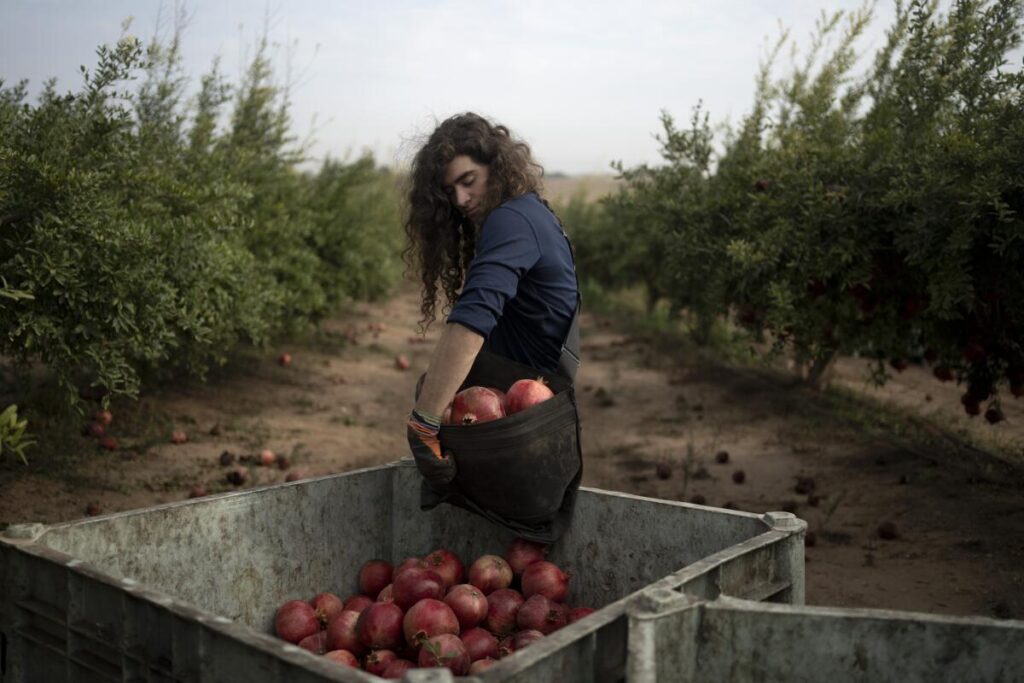
Volunteer efforts enlisting thousands of people have sprung up across the country to fill the gaps. At the 25-acre (10-hectare) Dafna family orchard near the southern town of Ashkelon, volunteers brave frequent air-raid sirens as they pull ripe pomegranates from trees bursting with pink fruit. Their bounty tumbles into large troughs bound for market. Without their labor, the fruit would rot.
“I’m not afraid to come here to help them,” said 21-year-old Ayelet Ben Assayag, who volunteered at the farm on a recent day. “I think it’s really important that we will come here, even though it’s a war zone.”
She said the volunteers were prepared to run toward small shelters or lie on the ground in the event of a siren.
But volunteers can only help so much, said Liad Vaknin, spokesperson for Israel’s Dairy Council. With the loss of skilled foreign labor, farming tasks take longer.
“The volunteers are temporarily saving these farms,” Vaknin said. ”But at the end of the day, they are volunteers. They don’t have the same capabilities as the workers. We need to find a more permanent solution.”
Volunteers have a harder time accessing the farms closest to the Gaza border, like Marcelo Wasser’s dairy, because they need a military escort to enter the area. Wasser runs one of the 16 dairies dotting the border that account for roughly 10% of Israel’s milk. Wasser stayed behind in Kibbutz Nirim to tend to his cows, as his family and community members evacuated.
After sheltering with his family for 12 hours in a safe room on Oct. 7, Wasser emerged to find five of his neighbors killed by militants and eight of his cows dead from rocket attacks.
Wasser, who immigrated to Israel from Argentina 30 years ago, continues to head out every day to feed and milk the cows, tending to the injured and dodging rocket fire as he goes.
“I’m scared for my life, not the cows’ lives,” he said. “I don’t know how much longer I can do this.”
___
Frankel reported from Jerusalem.