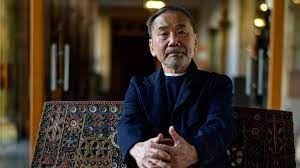
For Japanese author Haruki Murakami, the bloody conflict in the Gaza Strip is a horrendous example of how our world is divided by walls, both physical and metaphorical.
But while admitting he can only pray for peace now, he also feels confident that fiction, rather than offering an escape, can help us understand, and survive, increasingly perilous times.
“I have Jewish friends in Israel. And I’m also aware that the Palestinian situation that I saw when I visited Israel is miserable,” Murakami told The Associated Press in an interview. “So all I can say is to pray so that peace will prevail as soon as possible. I cannot say which (side) is right or wrong.”
The clash between Israel and the Hamas militant group has resonated with the title of Murakami’s newest novel “The City and Its Uncertain Walls,” which was published in Japanese this year and has yet to be translated into English.
“In my novels, walls are real walls. But of course they are also metaphoric walls at the same time,” the 74-year-old writer said. “For me, walls are very meaningful things. I’m a bit claustrophobic. If I’m locked up in a cramped space I may have a mild panic. So I often think about walls.”
Murakami spoke to the AP this week before he received Spain’s Princess of Asturias prize for literature in the northern Spanish city of Oviedo. Friday’s gala will be presided over by Princess Leonor de Borbón, the heir to Spain’s King Felipe VI. The 50,000-euro award ($52,900) is one of eight prizes covering the arts, communication, science and other areas that are handed out annually by the Princess of Asturias foundation.
The award’s jury highlighted Murakami’s “ability to reconcile Japanese tradition and the legacy of Western culture in an ambitious and innovative narrative.”
In his memoir on being a writer, “Novelist As a Vocation,” Murakami lays out his theory of “novelistic intelligence,” whereby writers, and readers, learn through fiction to avoid rash judgements and to accept — just like many of the protagonists in his novels and stories — that conclusive answers to real-life questions of love and loss are rarely found.
Reflecting on wisdom that is fostered by fiction, Murakami said that while journalism and breaking analysis of world events are necessary, “we also need metaphorical and slow information” to make sense of our reality, which is being quickly transformed by new technologies, while still riveted by apparently timeless religious and national conflicts.
“For instance, there is fake news. I think it is right to challenge that with fiction. I think that would be the power of novels,” he said. “Fake news has a slim chance of winning its fight against the truth. People who have acquired true stories can certainly see through lies.”
Murakami’s distinctive writing style, which combines an intimate narrative voice with surreal happenings navigated by vulnerable yet resilient protagonists, has won over millions of readers in Japan and around the globe. His novels, short-story collections and essays have sold millions of copies and been translated into over 40 languages.
Murakami’s 1987 novel “Norwegian Wood,” which took a more realistic approach to a story of reminiscing on young love, turned him into a star in Japan. His other novels that have triumphed globally include the enigmatic “The Wind-Up Bird Chronicle,” “Kafka on the Shore,” “After Dark” and “1Q84.”
His most recent short-story collection, “First Person Singular,” brings together tales about a talking monkey who steals names, a non-existent album by jazz musician Charlie Parker, and a yarn that features humorous yet moving poems on baseball, among others in another display of his wildly creative imagination.
Murakami has been considered for years one of the writers who could win the Nobel Prize for Literature. But it has yet to fall his way, often going to writers with smaller readerships, like this year’s winner, Norwegian Jon Fosse.
When asked if he minded being passed over, Murakami said he takes a stoic approach, only worrying about what is in his control: his own writing.
“Basically, I have a policy of not paying very much attention to prizes. It’s because (prizes) are decided based on someone else’s judgment. I’m interested in things in which I can make my own decisions,” he said. “So of course I’m honored to receive this (Princesa de Asturias) award, but it’s only a result. After all, the most wonderful thing is to be able to tell your own story.”
Murakami, who is an avid long-distance runner and has written about his need to be physically fit to endure long days tied to a desk, said he was still going strong despite his advanced age.
Currently, he is taking a break between books to recharge his creative batteries before delving into a new project.
“I’m already 74 years old, and I don’t know how many novels I can still write. So whatever I write, I will write it with great care,” he said.
And what if a digital “author” — a computer using artificial intelligence — were to challenge our monopoly on creative writing?
For Murakami, that won’t happen. His prodigious mind, he believes, still has the upper hand over any such copy since his convoluted stories only suggest meanings through the clouds of the unknown that surround his characters.
“When I’m writing a novel, my head is filled with bugs, but I still write novels using the brain,” he said. “If a computer was filled with as many bugs as I have, I think (it) would break down.”
____
AP writer Mari Yamaguchi contributed to this report from Tokyo.