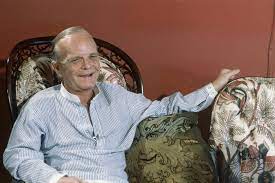
Along with such classics as “In Cold Blood” and “Breakfast at Tiffany’s,” Truman Capote had a history of work left uncompleted and unpublished.
Capote, who died in 1984 shortly before his 60th birthday, spent much of his latter years struggling to write his planned Proustian masterpiece “Answered Prayers,” of which only excerpts were released. As a young man, he wrote a novel about a love affair between a socialite and a parking lot attendant that was published posthumously under the title “Summer Crossing.”
Shorter work, too, was sometimes abandoned, including a piece released this week for the first time.
“I am so happy to be writing stories again — they are my great love,” he wrote to a friend.
“The past had trained her to envision an affair from a futureless angle; at the most, she hoped such episodes would end in friendship. It was so humiliating that Carlo should have turned out not to be a friend. She’d trusted him to the extent of her capital: let him sell her the land, allowed him to build the villa, supply, at pirate prices, the native paraphernalia that furnished it,” Capote wrote.
“He was an emotional crook and, beyond that, a common gangster who’d pocketed at least half the money supposedly spent on Belle Vista. All this she could forgive him — could, but didn’t. The unforgivable aspect of the ghastly man’s behavior was that it had destroyed the meaning of these lines in her journal: `I belong. At last, somewhere.’”
Much of Capote’s fiction was set in New York or in the American South, but “Another Day in Paradise” has the easy pace, decorative language and cutting — sometimes cruel — humor of his best known work, and the themes of loneliness, fear and regret. Thomas Fahy, author of “Understanding Truman Capote,” says that the author likely related to Iris Greentree’s sense of displacement and alienation.
“He was constantly moving around as a child, from New Orleans to Alabama to New York to Connecticut,” Fahy says. “You could see how his life became very lonely and isolated.”
The Strand has published rare works by Ernest Hemingway, John Steinbeck and many others. Managing editor Andrew Gulli found the Capote story in the Library of Congress, inside an “old red- and gold-scrolled Florentine notebook,” he writes on the Strand editorial page. The handwritten manuscript, worked in pencil, was at times so hard to make out that Gulli needed a transcriber to help prepare it for publication.
Fahy says that Capote’s time in Sicily, where he remained for just over a year, left him with the kind of feelings many authors have when away from their native countries — a heightened sense of distance from home that likely helped inspire “Another in Paradise,” and a heightened clarity. which he drew upon for “The Grass Harp” and its memories of his years in Monroeville, Alabama.
Capote biographer Gerard Clarke says that the author moved to Sicily in part because his partner, Jack Dunphy, wanted to live overseas, and because the strong American dollar made Italy more affordable than New York. Neither Clarke nor Fahy could cite a specific real-life model for Iris Greentree, but Capote does refer to a possible inspiration — the aunt of a boy who delivers ice — in his essay “Fontana Vecchia,” written in the early 1950s.
“Blond, witty, the ice boy is a scholarly-looking child of eleven. He has a beautiful young aunt, one of the most attractive girls I have ever known, and I often talk to him about her,” Capote writes. “Why, I wanted to know, does A., the aunt, have no beau? Why is she all alone, never at the dances or the Sunday promenades? The ice boy says it is because his aunt has no use for the local men, that she is very unhappy and longs only to go to America.”