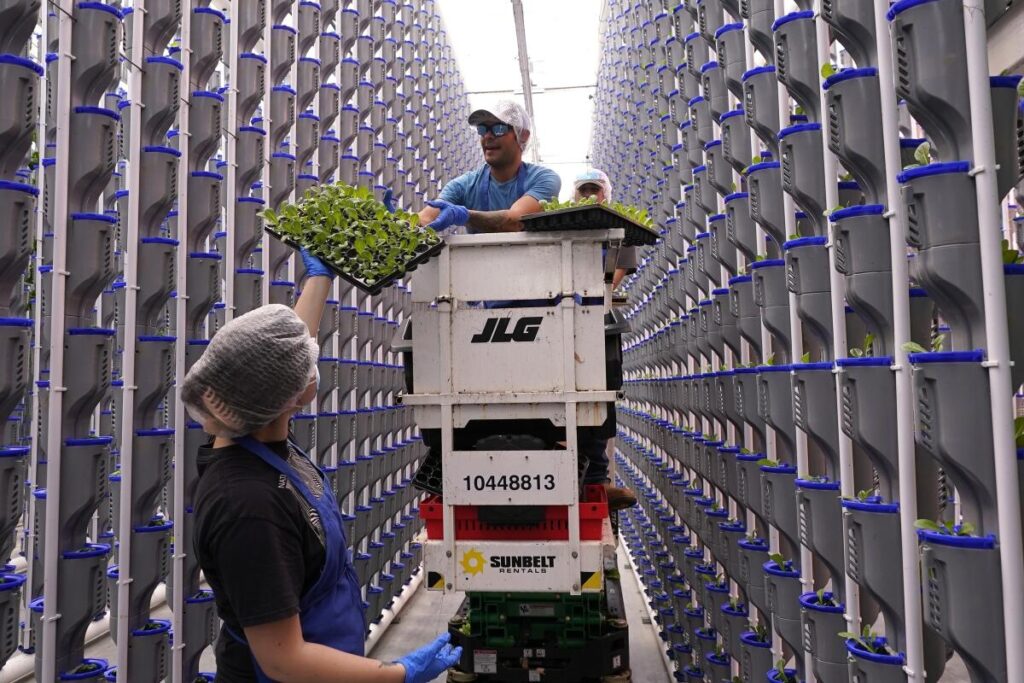
Inside a bright greenhouse about an hour outside Dallas, workers in hairnets and gloves place plugs of lettuce and other greens into small plastic containers — hundreds of thousands of them — that stack up to the ceiling. A few weeks later, once the vegetables grow to full size, they’ll be picked, packaged and shipped out to local shelves within 48 hours.
This is Eden Green Technology, one of the latest crop of indoor farming companies seeking their fortunes with green factories meant to pump out harvests of fresh produce all year long. The company operates two greenhouses and has broken ground on two more at its Cleburne campus, where the indoor facilities are meant to shelter their portion of the food supply from climate change while using less water and land.
But that’s if the concept works. And players in the industry are betting big even as rivals wobble and fail. California-based Plenty Unlimited this summer broke ground on a $300 million facility, while Kroger announced that it will be expanding its availability of vertically farmed produce. Meanwhile, two indoor farming companies that attracted strong startup money — New Jersey’s AeroFarms and Kentucky’s AppHarvest — filed for bankruptcy reorganization. And a five-year-old company in Detroit, Planted Detroit, shut its doors this summer, with the CEO citing financial problems just months after touting plans to open a second farm.
The industry churn doesn’t bother Jacob Portillo, a grower with Eden Green who directs a plant health team and monitors irrigation, nutrients and other factors related to crop needs.
“The fact that other people are failing and other people are succeeding, that’s going to happen in any industry you go to, but specifically for us, I think that especially as sustainable as we’re trying to be, the sustainable competitors I think are going to start winning,” he said.
Advocates say growing indoors uses less water and land and allows food to be grown closer to consumers, saving on transport. It’s also a way to protect crops from increasingly extreme weather caused by climate change. The companies frequently tout their products as free of pesticides, though they’re not typically marketed as organic.
But skeptics question the sustainability of operations that can require energy-intensive artificial light. And they say paying for that light can make profitability impossible.
Tom Kimmerer, a plant physiologist who taught at the University of Kentucky, has tracked indoor farming alongside his research into the growth of plants both outdoors and inside. He said his first thought on vertical farm startups — especially those heavily reliant on artificial light — was, “Boy, this is a dumb idea” — mainly due to high energy costs.
The industry has acknowledged those high costs. Some companies are seeking to push those down by relying on solar, which they say also supports sustainability. Even the ones most heavily reliant on artificial light that doesn’t come from renewables maintain they can be profitable by eventually producing a high volume of produce year-round.
But Kimmerer thinks there are better ways to provide food locally and extend the growing season — outdoors. He pointed to the organic farmstand-oriented Elmwood Stock Farm outside Lexington, Kentucky, which can grow tomatoes and greens the whole year using tools like high tunnels, also known as hoop houses — greenhouse-like arches that shelter crops while still being partially open to the outdoors.
He thinks investment flowing toward new versions of indoor farming would be better spent on practical solutions for outdoor farmers like weed-zapping robots, or even climate solutions like subsidizing farmers to adopt regenerative practices.
Moving farming indoors can solve some pest problems, but create new ones. Without their natural outdoor predators, tinier creatures like aphids, thrips and spider mites can become very difficult to control if not managed aggressively, said Hannah Burrack, an ecologist who specializes in pest management at Michigan State University.
“If you’re creating the perfect environment for plants, in many cases, you’re also creating a perfect growing environment for their pests,” Burrack said.
Indoor farming companies counter this by emphasizing high hygiene; for example, Eden Green touts “laboratory conditions” on its website and says workers closely monitor their greenhouses to immediately catch any pests. They also say vertical farms actually need fewer pesticides than outdoor farms do, reducing environmental impacts.
Evan Lucas, an associate professor of construction management at Northern Michigan University who teaches students about proper infrastructure design for indoor farms, said he’s not concerned about the shakeout underway. He said some companies may be struggling to scale up, with problems that come from launching in spaces that aren’t necessarily built specifically for indoor farming.
“My guess, based on what’s happening, is everyone saw the opportunity and started to try to do a lot really quickly,” Lucas said.
Several of the companies say they’re on the right track. Eden Green CEO Eddy Badrina says the company has figured out a way to rely mostly on natural light for their plants. Plenty CEO Arama Kukutai said the company’s lighting system is efficient enough for the company to be profitable. And Soli Organic CEO Matt Ryan said growing in soil indoors gives the company a better product than companies that grow in water.
Plenty got a significant vote of confidence last year when Walmart joined in a $400 million round of investment also aimed at bringing the company’s produce into its stores.
But Curt Covington, senior director of institutional business at AgAmerica Lending, a private investment manager and lender focused on agricultural land, isn’t convinced that indoor farming operations can work — except maybe in cases where big retailers and greenhouses team up, like Walmart and Plenty, or where grants for urban and vertical farm operations that benefit communities could be made as a form of socially conscious venture capital.
“It’s just hard, given the capital intensity of these types of businesses, to be very profitable,” Covington said.
___
Walling reported from Chicago and from Georgetown, Kentucky. Associated Press journalist Joshua A. Bickel contributed from Georgetown.
___
Follow Melina Walling on X, formerly known as Twitter: @MelinaWalling.
___
Associated Press climate and environmental coverage receives support from several private foundations. See more about AP’s climate initiative here. The AP is solely responsible for all content.